We are hiring passionate trainers to join our growing team! Share your expertise with aspiring professionals in a dynamic learning environment. Enjoy competitive compensation, flexible schedules, and rewarding teaching experiences. Whether you're a seasoned instructor or industry expert, we provide the platform to shape futures. Apply now to become part of our elite training team!
Featured Article
AI Agents vs Generative AI in 2026: Key Differences, Real-World Applications and Career Opportunities
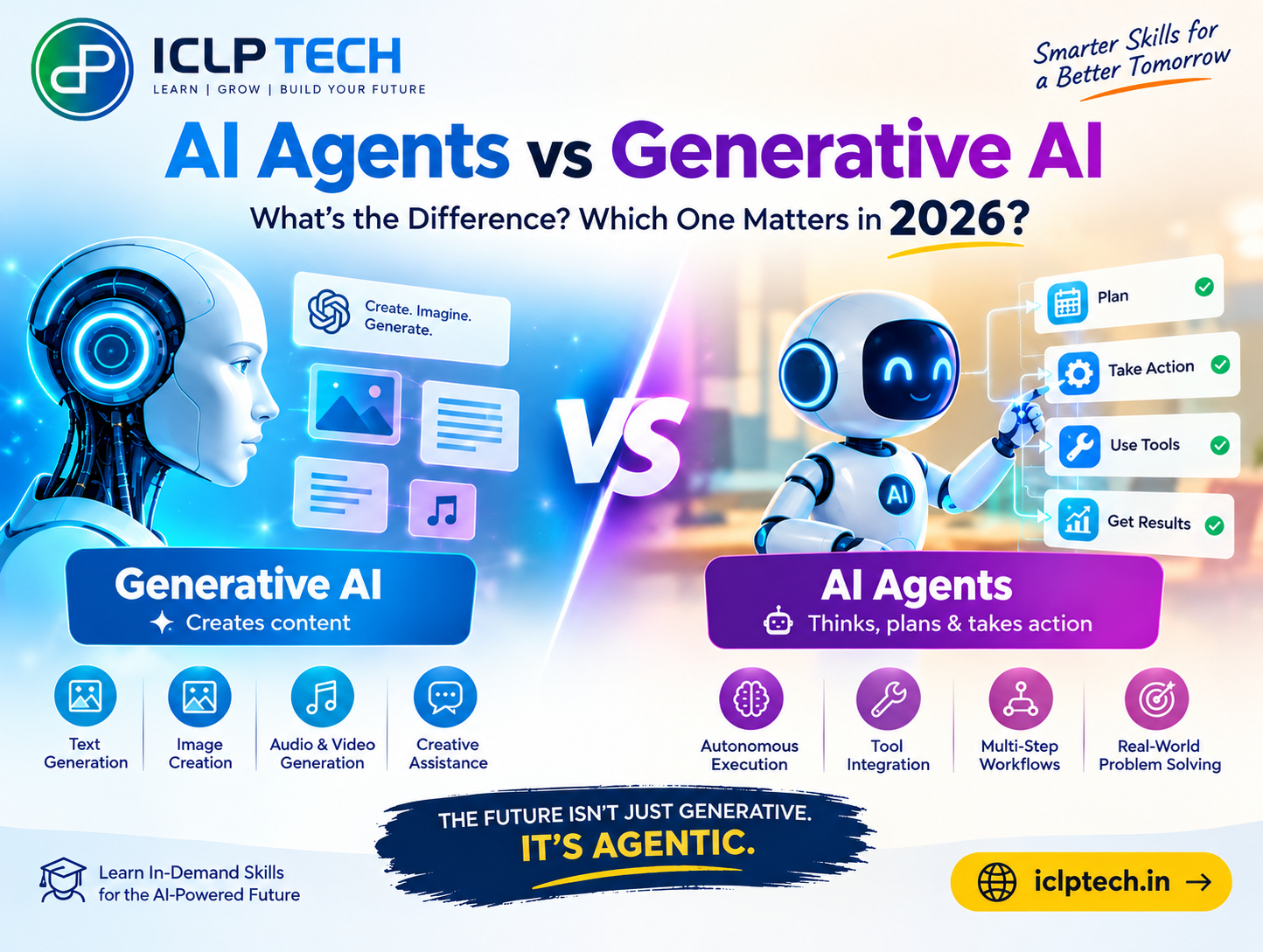
Artificial Intelligence is transforming how businesses create content, automate tasks and make decisions. From AI chatbots to intelligent automation systems, organisations are exploring new ways to improve productivity and customer experiences. Two important concepts gaining attention are Generative AI and AI Agents. Although these technologies are related, they serve different purposes. Generative AI focuses on creating content such as text, images, videos and code, while AI agents can use AI models, tools and workflows to complete tasks based on a defined goal. Understanding the difference between AI Agents vs Generative AI can help students, developers, working professionals and businesses identify the right technology for their needs. This guide explains how they work, their applications, essential skills and potential career opportunities in 2026.
8 min read
Published Today
Web Development
What Is Generative AI
Definition — A branch of artificial intelligence that produces new content based on user instructions, known as prompts, including written content, images, computer code, summaries, audio and other digital output. Examples — Popular examples include ChatGPT, Google Gemini and image-generation tools; developers can also integrate generative AI models into websites, applications and business systems through APIs. Content creation — Generate blog drafts, product descriptions, emails and social media ideas. Software development — Assist with code generation, debugging and documentation. Customer support — Create conversational responses to frequently asked questions. Data analysis — Summarise reports and help explain complex information. Education — Support personalised learning, explanations and practice exercises. Best suited for — Generative AI is especially useful when the main objective is to create information or assist a person with a specific task.
What Are AI Agents
Definition — Software systems designed to pursue a defined objective by interpreting information, selecting actions and interacting with available tools; depending on design, they can plan multiple steps, evaluate results and adjust their approach. Chatbot vs agent example — A conventional chatbot might explain how to schedule a meeting, while an AI agent connected to approved calendar tools could check availability, identify a suitable time and prepare a meeting invitation, subject to its permissions and approval rules. Building blocks — AI agents may use large language models, APIs, databases, external tools and memory mechanisms; their level of autonomy depends on the application and the controls set by developers. Customer service — Retrieve order information and assist with approved support workflows. Business automation — Coordinate repetitive tasks across connected applications. Software development — Help plan code changes, run tests and identify errors. Research assistance — Gather information from authorised sources and organise findings. Sales operations — Assist with lead research, CRM updates and follow-up preparation. IT operations — Analyse alerts and recommend or execute approved troubleshooting actions. Oversight — AI agents can reduce manual effort in suitable workflows, but they still require monitoring, security controls and human oversight for important decisions.
AI Agents vs Generative AI: Key Differences
Core difference — Generative AI produces content in response to instructions, while AI agents can use AI-generated reasoning and connected tools to work towards a goal. Main purpose — Generative AI generates content; AI agents complete defined tasks. Typical input — Generative AI takes a prompt or request; AI agents take a goal, instructions or trigger. Output — Generative AI produces text, images, code or summaries; AI agents produce actions, results or completed workflows. Tool usage — Optional for Generative AI; often central to the workflow for AI agents. Task execution — Generative AI usually responds to individual requests; AI agents can coordinate multiple steps. Human involvement — With Generative AI, people review the generated output; with AI agents, people set permissions and supervise actions. Example — Generative AI drafts a customer email; an AI agent drafts, checks and prepares an email workflow. Not mutually exclusive — An AI agent may use a generative AI model to understand instructions, create text or decide which tool to call, so generative AI can be a building block of an AI agent.
Real-World Applications of AI Agents and Generative AI
Customer Support Automation — Generative AI drafts responses, summarises conversations and explains product information; an AI agent can also retrieve information from approved systems, check policies and prepare a response or initiate an authorised action. Digital Marketing — Generative AI helps develop content ideas, write ad variations and summarise campaign performance; AI agents can collect campaign data, identify performance changes and prepare reports, with human review before publishing or changing budgets. Software Development — Generative AI suggests code, explains concepts and helps write tests; AI agents can inspect a codebase, propose changes, run tests and prepare a code review request. Data Analytics — Generative AI explains SQL queries, summarises dashboards and helps interpret data; AI agents can retrieve data from approved sources, run permitted analysis steps and prepare reports for review. Business Operations — Generative AI supports document creation, information extraction and summarisation; AI agents can connect multiple systems to process requests, update records and generate status reports. Choosing the right solution — The most suitable option depends on task complexity, data access, reliability requirements and the consequences of an incorrect action.
Which Skills Should You Learn for AI Career Opportunities in 2026
Python Programming — Learn variables, functions, data structures, APIs and error handling; Python is widely used for AI development and automation. Generative AI Fundamentals — Understand large language models, prompt engineering, model limitations and responsible AI usage. API Integration — Learn how applications exchange information and how to connect AI models with external services securely. AI Agent Development — Explore tool calling, workflow orchestration, task planning, memory and human approval mechanisms. Data Handling — Understand databases, structured data, retrieval methods and data privacy. Testing and Evaluation — Learn to assess accuracy, reliability, security and the quality of AI-generated results. Beginner projects — An AI-powered FAQ assistant, a document summarisation tool, or a research assistant that retrieves information from approved sources. Advanced projects — An agent that uses tools to complete a multi-step workflow with appropriate safeguards.
AI Agents vs Generative AI: Which Should You Learn First
If you are new to AI — Start with AI fundamentals, programming basics and generative AI concepts, which show how AI models process instructions and produce results. Then move to agents — Explore AI agents, API integration and workflow automation, and build small projects before progressing to systems that interact with business data or perform actions. Business users and digital marketers — Learning to apply generative AI tools may be a useful starting point. Developers — Can progress towards AI engineering and agent development.
Frequently Asked Questions
QIs Generative AI the same as Agentic AI?
No. Generative AI creates content, while Agentic AI refers to systems designed to pursue goals through planning, tool use and task execution. An AI agent may use a generative AI model as part of its workflow.
QCan AI agents work without human intervention?
Some agents can complete limited tasks independently within defined permissions. However, sensitive operations, financial decisions, changes to important records and other high-impact actions may require human approval and monitoring.
QIs Python required to learn AI agent development?
Python is a useful programming language for AI development, although some agent-building platforms support visual workflows or other programming languages. The right starting point depends on your goals and the tools you intend to use.
QWhat is the difference between AI agents and chatbots?
A traditional chatbot mainly responds to questions and instructions. An AI agent can go further by interacting with external tools, coordinating multiple steps and attempting to complete an assigned task. Some modern chatbots also include agent capabilities.
QWhat are the career opportunities in Generative AI and AI agent development?
Potential roles include AI application developer, AI engineer, machine learning engineer, automation developer and AI solutions specialist. Requirements vary by employer, and many technical positions require programming, integration, testing and problem-solving skills.
✨
Conclusion
Generative AI and AI agents are important technologies with different but complementary capabilities. Generative AI helps people create content and work with information, while AI agents can extend those capabilities by coordinating tools and completing defined tasks. In 2026, learning both technologies can help students and professionals understand modern AI applications and explore opportunities in software development, automation, data analytics and business technology. Start with the fundamentals, practise through projects and build your skills progressively. If you want to develop your AI knowledge, explore the artificial intelligence training options available at ICLP Tech and choose a learning path aligned with your experience and career goals.