We are hiring passionate trainers to join our growing team! Share your expertise with aspiring professionals in a dynamic learning environment. Enjoy competitive compensation, flexible schedules, and rewarding teaching experiences. Whether you're a seasoned instructor or industry expert, we provide the platform to shape futures. Apply now to become part of our elite training team!
Featured Article
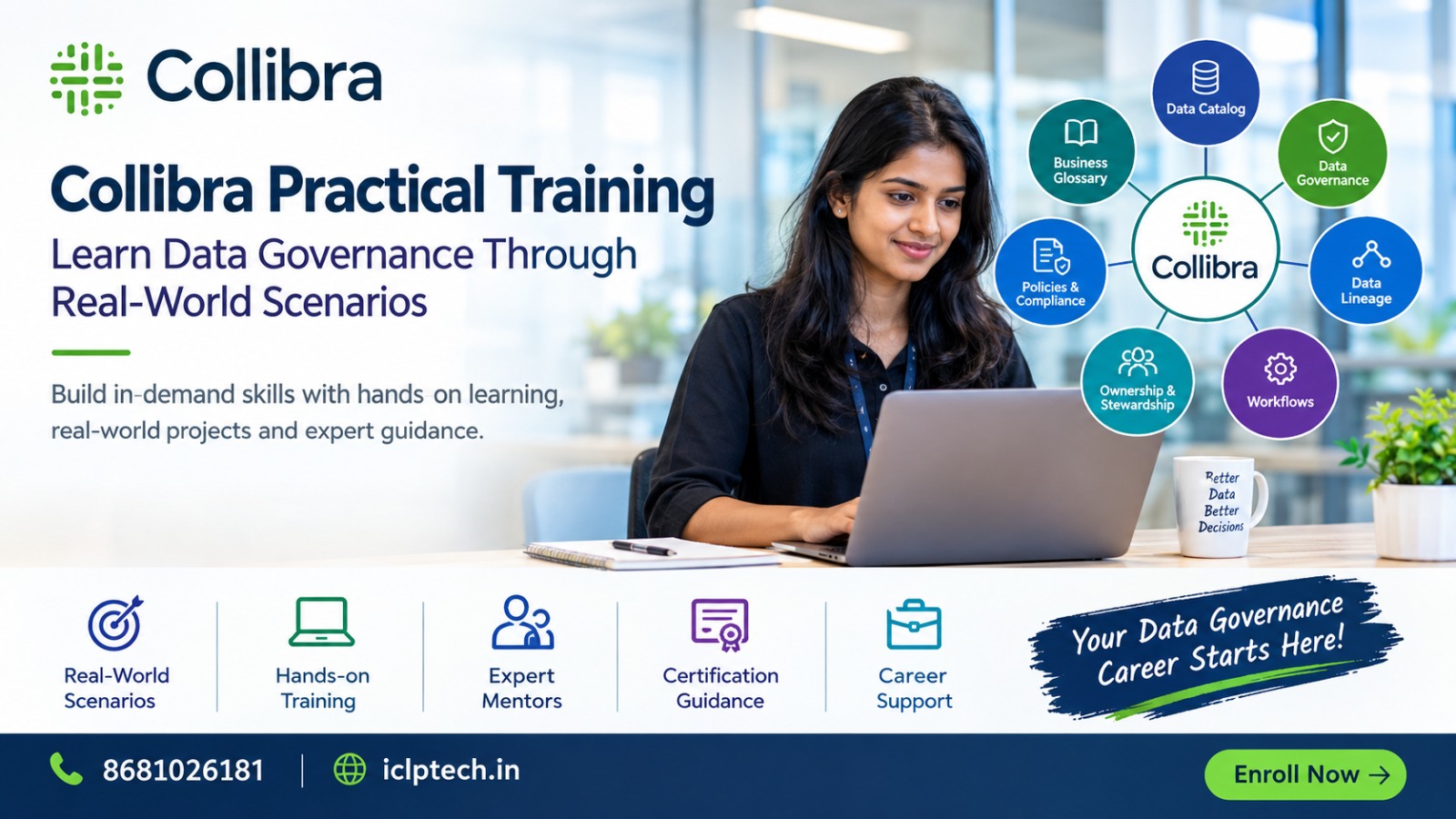
Collibra Practical Training: Learn Data Governance Through Real-World Scenarios
Data has become one of the most valuable assets for modern organizations. Businesses across industries rely on data for decision-making, compliance, analytics, customer experience, risk management, and digital transformation. However, simply having large amounts of data is not enough — organizations need to know where their data comes from, what it means, who owns it, how it is used, and whether it can be trusted. This is where data governance becomes important. Collibra is a widely used data intelligence and governance platform that helps organizations organize, govern, understand, and manage their data assets. Collibra Practical Training focuses on learning through realistic business scenarios instead of relying only on theoretical concepts, so learners understand how data assets, business terms, ownership, workflows, policies, classifications, and governance processes are handled in practical environments. Whether you are beginning your career in data governance or already working in data management, analytics, IT, compliance, or business intelligence, learning Collibra through practical exercises can help you understand how governance processes work in real organizational environments.
8 min read
Published Today
Web Development
What Is Collibra
Purpose — A data intelligence and governance platform designed to help organizations understand and manage their data landscape across databases, applications, cloud platforms, data warehouses, data lakes, and reporting systems. The problem it solves — Different teams often define the same business terms differently, which without governance can create confusion, inconsistent reporting, data-quality problems, and compliance risks. Key learning areas — Data governance, data cataloging, business glossary, data ownership, stewardship, policies, data quality, lineage, workflows, roles and responsibilities, classification, metadata management, and governance operating models. Beyond features — Practical Collibra learning focuses on how these capabilities apply to real business requirements, not just individual feature knowledge.
Why Learn Collibra Through Practical Training
Scenario 1: Business Glossary — Practicing standardized definitions for terms such as Customer, Account, Revenue, Loan, and Transaction for a financial organization. Scenario 2: Data Ownership — Demonstrating how ownership and stewardship responsibilities can be structured across thousands of data assets. Scenario 3: Governance Workflow — Understanding how a new business term or data asset moves through review and approval. Scenario 4: Data Lineage — Tracing where data originates and how it moves through systems before reaching reports or analytical applications.
Collibra Practical Training Modules
Module 1: Introduction to Data Governance — Governance fundamentals, frameworks, ownership, stewardship, policies, roles, and operating models. Module 2: Introduction to Collibra — Platform concepts, terminology, communities, domains, assets, relationships, and governance structures. Module 3: Data Catalog — Asset organization, discovery, relationships, data source concepts, ownership, and descriptions through sample business scenarios. Module 4: Business Glossary — Creating and managing terms like Customer, Product, Revenue, Employee, Supplier, Account, and Transaction, and linking them to data assets. Module 5: Roles, Responsibilities and Data Stewardship — Data owners, stewards, business and technical users, and responsibility assignments through real-world scenarios. Module 6: Workflows — Asset and term approval, review processes, governance requests, ownership assignment, and change management. Module 7: Data Lineage — Source systems, data movement, transformations, target systems, and impact analysis concepts. Module 8: Policies and Governance Standards — Data policies, governance standards, ownership policies, access-related concepts, and compliance considerations.
Hands-On Training Through Real-World Scenarios
Scenario: Customer Data Governance — Identify customer-related data assets, create standardized definitions, assign ownership, establish governance responsibilities, connect business terms to assets, define approval processes, and understand lineage. Scenario: Regulatory Data Requirement — Identify sensitive or regulated data and explore how governance teams organize related assets, classifications, policies, ownership, and review processes. Focus on the 'why' — The objective is to understand the business reason behind each governance activity rather than memorizing platform terminology.
Who Can Learn Collibra
IT Professionals and Data Engineers — Understanding how governance interacts with technology environments, platforms, pipelines, and lineage-related processes. Data Analysts and Business Analysts — Understanding data definitions, metadata, ownership, discovery, and how business terminology connects to governance processes. Data Governance and BI Professionals — Strengthening platform-oriented governance skills or understanding lineage, definitions, and data assets. Fresh Graduates — Starting with foundational concepts before progressing into practical scenarios in data management, analytics, or governance.
Prerequisites for Collibra Training
No advanced programming required — Collibra learning does not necessarily require advanced programming knowledge. Helpful background — Basic understanding of databases and SQL, familiarity with data concepts and metadata, basic understanding of business processes, and interest in data governance. Learn alongside the core concepts — Beginners can pick up these prerequisites while learning Collibra itself; professionals with data or compliance experience may already have several of these skills.
Collibra Learning Roadmap
Step 1: Data Fundamentals — Data, metadata, structured and unstructured data, databases, data quality, and data lifecycle. Step 2: Data Governance — Governance principles, ownership, stewardship, policies, standards, and roles. Step 3: Collibra Fundamentals — Assets, domains, communities, relationships, responsibilities, and business terms. Step 4: Data Catalog Practice — Data assets, metadata, asset discovery, and business context. Step 5: Business Glossary Practice — Creating sample terms and relationships between terms and data assets. Step 6: Workflows — Practicing approval and governance processes using realistic scenarios. Step 7: Lineage — Studying how data moves between source systems, transformations, and target applications. Step 8: End-to-End Projects — Combining multiple concepts into a complete governance scenario.
Certification and Career Preparation
Certification as one component — Useful for professional development but should be considered alongside practical knowledge rather than as a replacement for hands-on experience. Verify current requirements — Candidates should check the current certification structure, eligibility, exam details, and official resources directly with Collibra, since requirements can change. Preparation approach — Learning platform concepts, understanding governance, practicing terminology, working through scenarios, and building project knowledge.
Career Opportunities After Learning Collibra
Governance and analyst roles — Data Governance Analyst, Data Governance Consultant, Data Steward, Data Management Analyst, and Data Quality Analyst. Specialist roles — Metadata Analyst, Data Catalog Specialist, Business Data Analyst, Data Management Consultant, and Data Governance Specialist. Broader skill set — Career requirements vary by organization and may also call for SQL, database knowledge, cloud technologies, data quality tools, or industry-specific knowledge.
Why Practical Projects Matter
Sample project — Enterprise Customer Data Governance: identifying customer data assets, creating glossary terms, defining ownership, assigning stewardship, configuring workflows, documenting policies, and exploring lineage. Skills demonstrated — Data governance, data catalog, business glossary, metadata, ownership, workflows, data relationships, and governance processes. Interview value — Project-based learning makes technical concepts easier to explain during interviews.
Benefits of Collibra Practical Training
Better governance understanding — Learners see not just what governance is, but how governance activities are organized. Scenario-based and project exposure — Realistic scenarios and end-to-end projects connect technical concepts with business requirements. Improved platform familiarity — Hands-on exercises build comfort with Collibra terminology and workflows. Interview and career readiness — Practical experience gives candidates concrete examples to discuss, complementing existing skills in data management, analytics, and enterprise technology.
Frequently Asked Questions
QWhat is Collibra practical training?
Collibra practical training is a learning approach that combines data governance concepts with hands-on exercises and realistic business scenarios involving data assets, business terms, workflows, ownership, metadata, and governance processes.
QIs Collibra suitable for beginners?
Yes. Beginners can start with data fundamentals and governance concepts before progressing into Collibra-specific topics and practical scenarios.
QDo I need programming knowledge to learn Collibra?
Advanced programming knowledge is not necessarily required for learning core data governance concepts. Basic database, SQL, metadata, and enterprise-data knowledge can be useful.
QWho should learn Collibra?
Data analysts, business analysts, data governance professionals, data engineers, BI professionals, IT professionals, data management professionals, and graduates interested in data governance can consider learning Collibra.
QWhat topics are covered in Collibra training?
Topics can include data governance, data catalog, business glossary, metadata, assets, domains, ownership, stewardship, workflows, policies, relationships, and data lineage concepts.
QDoes practical training include projects?
A project-oriented program can include realistic business scenarios and end-to-end governance exercises. Project structure depends on the training provider and curriculum.
QCan Collibra help with a data governance career?
Collibra knowledge can complement careers involving data governance, data management, data stewardship, metadata, data quality, and data intelligence.
QIs certification necessary for a Collibra career?
Certification is not the only factor involved in career development. Practical skills, governance knowledge, project exposure, technical knowledge, and relevant professional experience can also be important.
QCan freshers learn Collibra?
Yes. Freshers can begin with data fundamentals, databases, metadata, and data governance before moving into platform-specific practical learning.
QHow long does it take to learn Collibra?
The learning duration depends on prior knowledge, course depth, practice time, and the scope of the curriculum. A structured roadmap can help learners progress from fundamentals to practical projects.
✨
Conclusion
Data governance has become an important part of modern enterprise data management. Organizations need reliable definitions, clear ownership, discoverable data, appropriate governance processes, and better visibility into how data is used. Collibra provides a platform through which organizations can organize and manage many of these governance-related activities. However, learning Collibra effectively involves more than memorizing platform terminology — practical, scenario-based learning helps learners understand how data assets, business terms, ownership, workflows, policies, metadata, and lineage-related concepts fit into real business processes. For professionals and graduates interested in data governance and data management, building Collibra knowledge alongside complementary skills such as SQL, databases, data quality, analytics, and enterprise systems can create a broader technical foundation. At ICLP Technologies, learners can build practical skills in Collibra and data governance through real-world scenarios, hands-on exercises, expert guidance, learning materials, recordings, project support, resume preparation, and interview-oriented guidance.