We are hiring passionate trainers to join our growing team! Share your expertise with aspiring professionals in a dynamic learning environment. Enjoy competitive compensation, flexible schedules, and rewarding teaching experiences. Whether you're a seasoned instructor or industry expert, we provide the platform to shape futures. Apply now to become part of our elite training team!
Featured Article
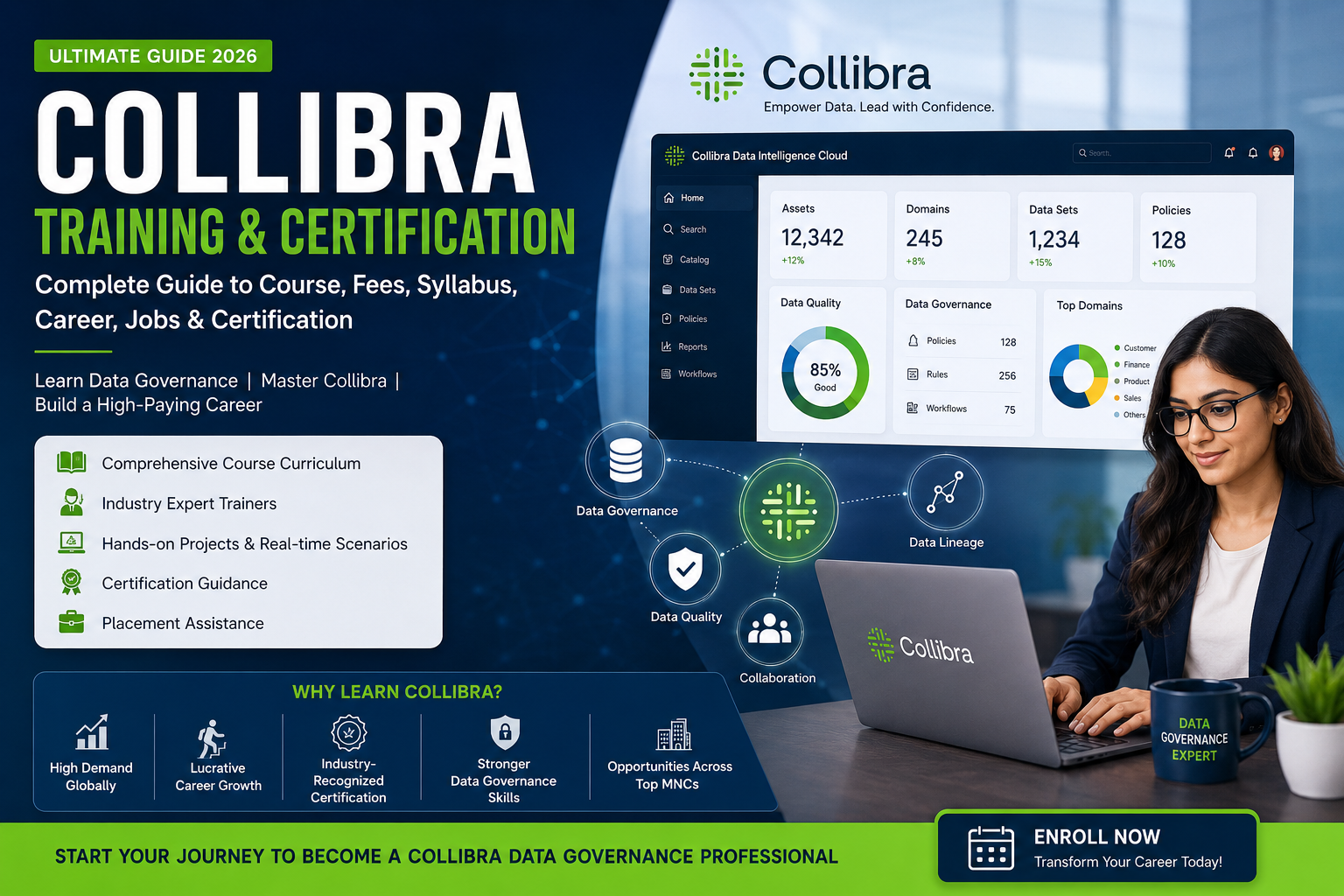
Collibra Training & Certification 2026: Complete Guide to Course, Fees, Syllabus, Career, Jobs & Certification
Data is everywhere. Every business today collects information from customers, employees, applications, websites, databases, cloud platforms, financial systems, and business operations. But having a large amount of data does not automatically mean that the data is useful or trustworthy. A business also needs to know where its data comes from, what it means, who is responsible for it, whether it is accurate, and how it is being used. This is where Data Governance becomes important. Collibra is a data intelligence and governance platform that helps organizations bring structure and visibility to their data. It can support areas such as data cataloging, metadata management, business glossary, data lineage, data governance, data quality, and data stewardship. As organizations continue to invest in data management, compliance, analytics, and data-driven decision-making, Collibra skills are becoming increasingly relevant for professionals looking to build a career in the data governance domain. If you are searching for Collibra Training in Chennai, this guide covers the important things you need to know before choosing a course — including syllabus, fees, certification, career opportunities, job roles, skills, and future scope.
8 min read
Published Today
Web Development
What Is Collibra?
Platform purpose — Collibra is a platform designed to help organizations understand, organize, govern, and manage their data. Common enterprise challenge — In large organizations, customer information may be stored across several applications, teams may use different definitions for the same term, and employees may not know which data source is reliable. Structured visibility — Collibra provides a structured environment for managing this information and making data easier to discover and understand. Best suited for complex environments — Especially useful when organizations have large, complex data environments and need better visibility into their data assets. Core capabilities — Covers data governance, data catalog, business glossary, metadata management, data lineage, data quality, and data stewardship. Extended capabilities — Also spans data ownership, data policies, data classification, and broader data intelligence. Learning ecosystem — Collibra's official education program offers role-based learning, self-paced courses, instructor-led training, and certification paths for different levels of users.
Why Is Collibra Important for Data Governance?
Growing complexity — Managing data becomes increasingly difficult as organizations grow, with information spread across databases, cloud platforms, data warehouses, applications, and reporting systems. Common governance problems — Without proper governance, teams can face inconsistent definitions, poor data quality, unclear ownership, and difficulty identifying the right source of information. Collibra's role — Collibra helps create a more organized approach to these challenges. Key questions it answers — Who owns a particular data asset, what does a specific business term mean, where did the data originate, and which reports use this data. Additional questions — Whether the data is trustworthy, what policies apply, and who should be contacted when there is a data issue. Beyond the software — Learning Collibra also involves understanding how businesses manage data, define responsibilities, maintain quality, and establish trust in information.
Collibra Training Course Overview
Goal of a good program — A good Collibra training program should take learners from data governance fundamentals to practical platform usage. Foundational topics — Introduction to data governance, Collibra fundamentals, platform overview, data catalog, and business glossary. Core platform topics — Metadata management, data assets and domains, data ownership, data stewardship, and data lineage. Governance and operations — Data quality governance, operating model, workflows, roles and responsibilities, and policies and standards. Applied and technical topics — Data governance use cases, administration basics, integration concepts, real-time business scenarios, practical projects, and interview preparation. What to look for — The most useful courses explain why a particular Collibra feature is used rather than simply showing where to click, which makes learning easier for beginners connecting the platform to real business requirements.
Collibra Course Fees in 2026
No fixed price — There is no single standard Collibra training fee; it depends on the training provider, course duration, delivery format, and services included. Indian market range — Public listings show variation, with some providers around ₹15,000–₹16,500 and live instructor-led programs priced considerably higher. What can affect the price — Live instructor-led sessions, hands-on practice, project work, and recorded sessions. Additional value-adds — Course materials, interview preparation, certification guidance, resume support, placement assistance, and lifetime or limited access. Look beyond the price tag — A cheaper course is not necessarily the better option if it provides only recorded videos and little practical support.
Collibra Certification in 2026
Role-based paths — Collibra offers role- and experience-based certification paths rather than a single certification that applies to everyone. Deprecated path — The older Integration Engineer certification was marked for deprecation on December 31, 2025, so it should not be treated as a current 2026 path. Data Steward — Designed for professionals involved in data governance processes, data assets, data quality responsibilities, and collaboration with stakeholders. Data Quality Steward — Focuses on data quality, monitoring, reliability, data issues, policies, and compliance-related responsibilities. Workflow Developer — A more technical path for professionals interested in designing and building workflows and governance processes within Collibra. Solution Architect — Aimed at professionals providing technical leadership for the design, planning, and implementation of the Collibra Platform. Collibra Ranger — Represents an advanced level of expertise for experienced professionals who bridge business requirements and technical execution and help drive broader data and AI governance initiatives.
How to Get Collibra Certification
Exam formats vary — Certification exams can include non-proctored multiple-choice exams, proctored multiple-choice exams, and scenario-based practical exams, depending on the certification. Training isn't automatic certification — Completing a training course does not automatically make someone Collibra-certified; the applicable examination must be passed. Step 1 & 2 — Learn data governance fundamentals, then build practical Collibra knowledge. Step 3 & 4 — Choose a certification path that matches your role, then complete the required learning and preparation. Step 5 & 6 — Review the certification requirements through Collibra University, then schedule and complete the applicable examination.
Is Collibra Certification Worth It?
Strengthens your profile — A certification can demonstrate that you have studied a defined set of Collibra skills, particularly when combined with practical experience. Certification isn't everything — A professional who can explain a real data governance problem and how Collibra could address it generally has a stronger profile than someone who has only memorized certification questions. Core areas covered — Data governance principles, metadata, data cataloging, and data quality. Additional areas covered — Data lineage, data stewardship, Collibra platform capabilities, and business requirements.
Why Learn Collibra in 2026?
Growing importance — Data governance is becoming increasingly important as businesses depend on data for reporting, analytics, operations, compliance, and decision-making. Broad learning ecosystem — Collibra University currently includes more than 200 free self-paced courses, along with instructor-led training and advanced education options. Multiple learning paths — There are several ways to build Collibra knowledge, from introductory learning to role-specific and certification-oriented development. What learners come to understand — What data an organization has, where it comes from, and who owns it. Further understanding — How the data should be used, whether it is reliable, how it moves across systems, and which policies apply to it.
Who Should Learn Collibra?
Data Analysts — Can strengthen their understanding of data definitions, data discovery, governance, and lineage. Business Analysts — Can benefit from learning business glossary, data ownership, and governance concepts. Data Engineers — Can develop a better understanding of metadata, lineage, cataloging, and governance requirements. Data Architects — Can use Collibra knowledge when working on enterprise data governance and information architecture initiatives. Data Stewards — Especially relevant for professionals responsible for data ownership, definitions, governance, and quality. IT Professionals — Can add data governance and enterprise data management skills to their existing technical background. Working Professionals — Can use structured training to build the foundation needed to move into data governance, data management, or Collibra consulting. Fresh Graduates — Can consider Collibra as a specialized career path if interested in data, analytics, governance, and enterprise technology.
Career Opportunities After Collibra Training
Wide range of roles — Learning Collibra can lead to several roles within the data governance and data management ecosystem. Depends on background — The actual role depends on previous experience, technical knowledge, governance knowledge, project exposure, and certification level. Consulting roles — Collibra Consultant, Collibra Functional Consultant, and Data Governance Consultant. Analyst roles — Data Governance Analyst, Data Steward, Data Quality Analyst, and Metadata Management Specialist. Specialized and leadership roles — Data Management Consultant, Collibra Workflow Developer, Collibra Solution Architect, Data Governance Lead, and Enterprise Data Management Consultant. Certification reflects career paths — Collibra organizes certifications around roles such as Data Steward, Data Quality Steward, Workflow Developer, Solution Architect, and Ranger.
Collibra Jobs and Career Opportunities in India
Connected job areas — Collibra-related jobs generally connect to data governance, data management, metadata management, data quality, data cataloging, enterprise data architecture, data intelligence, and compliance and risk. Broaden your job search — It helps to search not only for "Collibra Consultant" roles but also related titles such as Data Governance Analyst, Data Steward, Metadata Analyst, and Data Quality Analyst. Key hiring industries — Banking and financial services, healthcare, insurance, retail, and manufacturing. Additional hiring industries — Telecommunications, IT services, consulting, technology, and government and public sector.
Collibra Salary in India
Depends on several factors — Salary depends heavily on experience, location, role, certification, technical skills, and previous domain knowledge. No guaranteed outcome — Learning Collibra alone does not automatically result in a particular salary; candidates should focus on building a strong combination of skills. What builds earning potential — Collibra skills, data governance knowledge, data management experience, and metadata knowledge. Further factors — Data quality understanding, communication skills, project experience, and certification. Career progression — Professionals who move from basic governance responsibilities into consulting, architecture, workflow development, or leadership roles may access broader career opportunities.
How to Choose the Best Collibra Training in Chennai
Compare content, not claims — Don't choose a course only because it says "Best Collibra Training in Chennai"; check what you are actually getting. Trainer and curriculum quality — Look for experienced trainers and an updated 2026 syllabus. Core topics to check — Data governance fundamentals, data catalog training, business glossary, metadata management, data lineage, and data quality. Applied learning — Workflows, practical assignments, real-time projects, and a hands-on Collibra environment. Career support — Certification guidance, interview preparation, resume support, and placement assistance. Why it matters — A course that connects Collibra functionality with real business scenarios can make a major difference in how confidently you approach interviews and projects.
Collibra Training in Chennai for Career Development
Strong local ecosystem — Chennai has a strong IT, consulting, analytics, banking, manufacturing, and enterprise technology ecosystem. Attractive for specialization — This creates an attractive environment for professionals interested in developing specialized data governance skills. Learn the full concept — For learners searching for Collibra Training in Chennai, focus on learning the complete concept rather than only preparing for a certification. Suggested learning path — Start with data governance fundamentals, move into Collibra, then learn cataloging, metadata, business glossary, lineage, data quality, workflows, and advanced governance concepts for a stronger foundation with real enterprise data environments.
What Is the Future of Collibra?
Closely tied to trust in data — The future of enterprise data management is closely connected to the ability to understand, govern, and trust data. Growing complexity — Organizations are working with increasingly complex data environments, including cloud platforms, data warehouses, analytics systems, applications, and enterprise data products. Stronger governance needed — As these environments grow, businesses need stronger ways to understand data ownership, definitions, quality, lineage, policies, and usage. Collibra's positioning — Collibra is positioning its platform around data intelligence and governance, while its education and certification programs continue to develop role-based expertise. Winning combination — Collibra + Data Governance + Metadata + Data Quality + Data Lineage + Business Understanding can better prepare professionals for the changing requirements of enterprise data management.
Frequently Asked Questions
QWhat is Collibra?
Collibra is a data intelligence and governance platform used by organizations to manage and understand data assets, metadata, governance processes, data quality, lineage, and business definitions.
QIs Collibra a good career option in 2026?
Collibra can be a valuable specialization for professionals interested in data governance, metadata management, data quality, data management, and enterprise data intelligence.
QWhat is covered in Collibra Training?
A comprehensive course can cover Data Governance, Collibra fundamentals, Data Catalog, Business Glossary, Metadata Management, Data Lineage, Data Quality, Data Stewardship, Workflows, Administration, Integration concepts, and practical projects.
QWhat is the Collibra course fee?
There is no single standard fee. Training prices vary depending on the institute, duration, training format, practical sessions, projects, trainer support, and additional career services. Current public Indian listings show courses ranging from around ₹15,000 for some formats to ₹30,000+ for certain live instructor-led programs.
QIs Collibra certification available in 2026?
Yes. Collibra currently offers role-based certification paths including Data Steward, Data Quality Steward, Workflow Developer, Solution Architect, and Collibra Ranger.
QDoes completing Collibra training give me official certification?
Not automatically. Training completion and official Collibra certification are separate. Candidates need to meet the applicable requirements and pass the relevant certification examination.
QWho can learn Collibra?
Data analysts, business analysts, data engineers, data architects, data stewards, IT professionals, working professionals, and graduates interested in data governance can consider learning Collibra.
QIs coding required to learn Collibra?
Basic Collibra and data governance learning does not necessarily require advanced programming. However, professionals moving into technical areas such as workflows, APIs, integrations, or advanced platform development may benefit from technical and programming knowledge.
QWhat jobs can I get after Collibra Training?
Potential roles include Collibra Consultant, Data Governance Analyst, Data Steward, Data Quality Analyst, Metadata Management Specialist, Data Governance Consultant, Workflow Developer, and Solution Architect.
Collibra sits at the center of how modern organizations bring structure, trust, and accountability to their data, and that role is only growing as data environments become more complex. From data cataloging and business glossaries through metadata management, lineage, quality, and stewardship, a strong Collibra foundation touches nearly every part of enterprise data governance. Professionals who combine platform skills with genuine data governance understanding, and who pursue the certification path that matches their role, position themselves well for consulting, analyst, and architecture careers in this space. If you're ready to build these skills, enrolling in a structured Collibra training program with real business scenarios and practical projects can help you take the first step toward a rewarding data governance career.