We are hiring passionate trainers to join our growing team! Share your expertise with aspiring professionals in a dynamic learning environment. Enjoy competitive compensation, flexible schedules, and rewarding teaching experiences. Whether you're a seasoned instructor or industry expert, we provide the platform to shape futures. Apply now to become part of our elite training team!
Featured Article
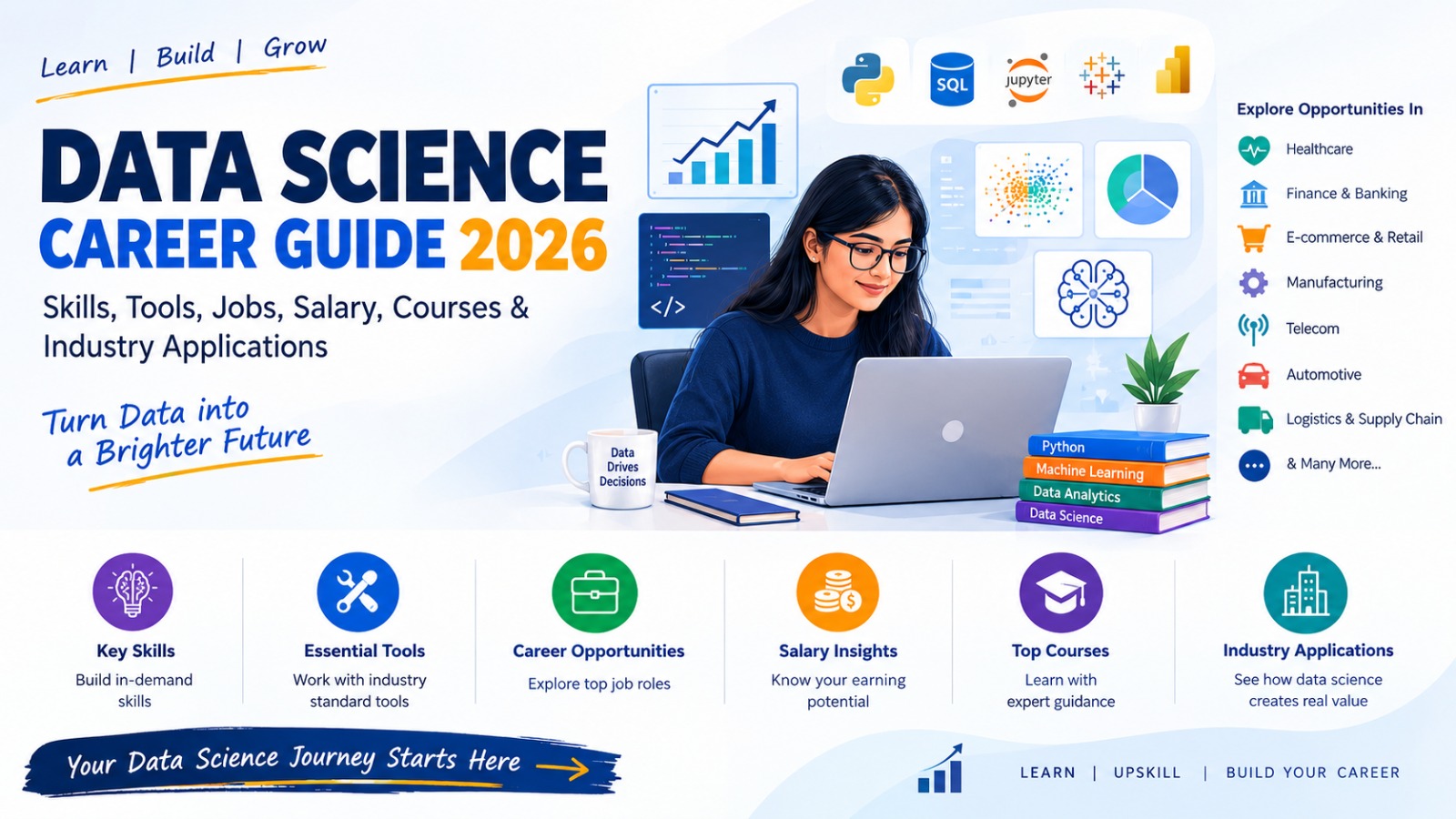
Data Science Career Guide 2026: Skills, Tools, Jobs, Salary, Courses & Industry Applications
Data Science has become one of the most important technology and business fields as organizations increasingly rely on data to make better decisions, understand customers, optimize operations, detect risks, and develop intelligent products. From banking and healthcare to e-commerce, manufacturing, telecommunications, logistics, and software, companies use data science to transform large volumes of data into meaningful insights and predictive solutions. A career in Data Science can be suitable for graduates, IT professionals, software developers, analysts, engineers, business professionals, and anyone interested in working with data, programming, statistics, machine learning, and artificial intelligence. This Data Science Career Guide 2026 explains what Data Science is, why you should learn it, who can learn it, the skills and tools required, career opportunities, salary expectations, courses, and how different industries use Data Science.
8 min read
Published Today
Web Development
What Is Data Science
Definition — A multidisciplinary field combining statistics, mathematics, programming, data analytics, machine learning, artificial intelligence, data visualization, and business intelligence. Objective — Collect, process, analyze, and interpret data to discover patterns, generate insights, make predictions, and support business decisions. Typical project flow — Data Collection → Data Cleaning → Data Exploration → Data Analysis → Feature Engineering → Model Building → Model Evaluation → Deployment → Monitoring.
Why Should You Learn Data Science in 2026
Growing use of data — Organizations generate enormous amounts of data from websites, applications, transactions, customer interactions, IoT devices, social media, and business systems, and need professionals who can turn it into useful information. AI and machine learning growth — Machine learning models require quality data for training, testing, and continuous improvement, so Data Science is a strong foundation for ML and AI careers. Wide range of career opportunities — Data Scientist, Data Analyst, Machine Learning Engineer, Data Engineer, AI Engineer, Business Analyst, BI Analyst, Research Analyst, and ML Researcher. Cross-industry opportunities — Used across healthcare, banking, insurance, retail, manufacturing, pharmaceuticals, logistics, telecommunications, automotive, and many other sectors. Business decision-making — Companies use data to understand what customers want, which products perform well, where costs can be reduced, which customers may leave, what future demand may look like, and which risks need attention.
Who Can Learn Data Science
Students and Graduates — Graduates from computer science, IT, engineering, mathematics, statistics, and related disciplines can build Data Science skills. IT Professionals — Software developers, testers, database professionals, and cloud professionals can expand their career options. Data Analysts — Can move toward advanced analytics, machine learning, and Data Science roles by developing programming and ML skills. Business Professionals — Professionals in finance, marketing, operations, sales, supply chain, and business analysis can strengthen their analytical capabilities. Non-IT Professionals — Can also learn Data Science, though they may need to build foundations in programming, mathematics, statistics, and data analysis.
Prerequisites for Learning Data Science
No expert level needed — You don't necessarily need to be an expert programmer or mathematician before starting. Helpful background — Basic mathematics, basic statistics, logical thinking, problem-solving, basic programming, SQL fundamentals, and an understanding of spreadsheets. Where to start — For beginners, Python is generally a good first language because of its extensive Data Science ecosystem.
Important Data Science Skills
Programming — Python is one of the most widely used languages; R and SQL are also common depending on the organization and role. Statistics — Mean, median and mode, probability, standard deviation, distributions, correlation, regression, hypothesis testing, and statistical significance. Data Analysis — Cleaning data, handling missing values, identifying outliers, analyzing patterns, transforming data, and exploring datasets. Machine Learning — Supervised and unsupervised learning, regression, classification, clustering, decision trees, random forests, ensemble methods, and model evaluation. Data Visualization — Communicating findings clearly through charts, dashboards, and reports. Business Understanding — Technical skills alone are not enough; professionals should understand the business problem they are solving.
Data Science Tools and Technologies
Programming — Python, R, and SQL. Python libraries — NumPy, Pandas, Matplotlib, Seaborn, and Scikit-learn. Machine Learning and AI — TensorFlow, PyTorch, Keras, and Scikit-learn. Development and analysis — Jupyter Notebook, Google Colab, and VS Code. Data visualization — Power BI, Tableau, Matplotlib, and Seaborn. Databases — MySQL, PostgreSQL, Microsoft SQL Server, and Oracle Database. Big data technologies — Depending on the role, Apache Spark, Hadoop, Databricks, and cloud data platforms. Cloud platforms — AWS, Microsoft Azure, and Google Cloud.
Career Opportunities After Learning Data Science
Data Scientist — Analyzes complex datasets and develops statistical and machine learning models to solve business problems. Data Analyst — Works with datasets to identify trends, generate reports, and provide insights. Machine Learning Engineer — Builds, deploys, and maintains machine learning systems. Data Engineer — Develops the data pipelines and infrastructure needed to collect, process, and store data. AI Engineer — Develops applications using machine learning, deep learning, natural language processing, computer vision, and other AI technologies. Business Analyst — Uses data and business requirements to support organizational decision-making. BI Analyst — Uses visualization and reporting platforms to create dashboards and business insights.
Data Science Salary in India
What affects salary — Experience, technical skills, location, company, industry, and job role. 0–2 years — Junior Data Analyst / Junior Data Scientist. 2–5 years — Data Scientist / ML Engineer. 5–8 years — Senior Data Scientist / Senior ML Engineer. 8+ years — Lead Data Scientist / AI Lead / Data Science Manager. Beyond salary — Build strong skills in Python, SQL, statistics, machine learning, data visualization, cloud platforms, and real-world projects.
Industries Using Data Science
Banking and Financial Services — Fraud detection, credit risk analysis, customer segmentation, algorithmic trading, risk management, and financial forecasting. Healthcare and Pharmaceuticals — Patient analytics, medical research, drug discovery, clinical research, disease prediction, and healthcare operations. E-Commerce — Product recommendations, customer segmentation, demand forecasting, price optimization, fraud detection, and customer behavior analysis. Retail — Inventory management, sales forecasting, customer experience, product recommendations, and store performance. Manufacturing — Predictive maintenance, quality control, production optimization, demand forecasting, and supply chain analytics. Telecommunications — Customer churn prediction, network optimization, customer segmentation, fraud detection, and demand forecasting. Automotive — Connected vehicles, predictive maintenance, customer analytics, autonomous driving research, and manufacturing optimization. Logistics and Supply Chain — Route optimization, demand forecasting, inventory optimization, delivery prediction, and warehouse analytics. Insurance — Risk assessment, fraud detection, claims analysis, customer segmentation, and pricing analytics. Media and Entertainment — Viewer preferences, content recommendations, audience behavior, advertising performance, and content performance.
Real-World Data Science Applications
Recommendation Systems — E-commerce and streaming platforms analyze user behavior to recommend relevant products or content. Fraud Detection — Machine learning models identify unusual transaction patterns and potential fraudulent activity. Customer Churn Prediction — Companies identify customers who may stop using a product or service. Demand Forecasting — Historical and current data is used to estimate future demand. Predictive Maintenance — Manufacturers analyze equipment data to predict failures before they occur. Customer Segmentation — Customers are grouped by characteristics and behavior to develop targeted strategies.
Data Science Projects for Beginners
Prediction projects — House Price Prediction, Customer Churn Prediction, Employee Attrition Prediction, and Sales Forecasting. Analysis projects — Customer Segmentation, E-Commerce Customer Analysis, Stock Market Data Analysis, and Healthcare Data Analysis. Applied ML projects — Movie Recommendation System and Credit Card Fraud Detection. Interview value — Building projects helps candidates demonstrate their skills during interviews.
Data Science vs Data Analytics vs Machine Learning
Data Analytics — Understanding existing data and generating insights. Data Science — Using data, statistics, programming, and ML to solve complex problems. Machine Learning — Building systems that learn patterns from data. Data Engineering — Building infrastructure and pipelines for data. Overlap — These areas overlap, but each has a different primary focus.
How to Start a Career in Data Science
Step 1: Learn Python fundamentals. Step 2: Learn SQL. Step 3: Learn statistics. Step 4: Learn Pandas and NumPy. Step 5: Learn data visualization. Step 6: Learn machine learning. Step 7: Build practical projects. Step 8: Create a strong resume and portfolio. Step 9: Practice technical interviews. Step 10: Apply for relevant entry-level positions. Keep learning — Continuous learning is particularly important because Data Science, machine learning, and AI technologies continue to evolve.
Frequently Asked Questions
QIs Data Science a good career in 2026?
Yes. Data Science continues to be an important technology and business field because organizations across industries increasingly rely on data, analytics, machine learning, and AI.
QCan a fresher learn Data Science?
Yes. Freshers can learn Data Science by starting with programming, statistics, SQL, data analysis, and machine learning fundamentals.
QIs coding required for Data Science?
Yes. Programming is an important part of most Data Science roles. Python is particularly useful for data analysis and machine learning.
QCan non-IT professionals learn Data Science?
Yes. Non-IT professionals can learn Data Science, although they may need additional time to develop programming, statistics, and analytical skills.
QWhich programming language is best for Data Science?
Python is one of the most popular choices because it has a large ecosystem of libraries for data analysis, visualization, machine learning, and AI.
QIs SQL required for Data Science?
SQL is highly useful because Data Scientists and analysts frequently need to retrieve and analyze information stored in databases.
QWhat tools are used in Data Science?
Common tools include Python, SQL, Pandas, NumPy, Scikit-learn, Matplotlib, Seaborn, Jupyter Notebook, TensorFlow, PyTorch, Power BI, Tableau, and cloud platforms.
QWhat jobs can I get after learning Data Science?
Depending on your skills and experience, potential roles include Data Analyst, Data Scientist, Machine Learning Engineer, Data Engineer, AI Engineer, BI Analyst, and Business Analyst.
QHow long does it take to learn Data Science?
The time varies depending on your background, learning schedule, and target role. A structured learning path covering Python, SQL, statistics, machine learning, and projects can provide a strong foundation.
QDoes Data Science require mathematics?
Basic mathematics and statistics are important. Advanced roles may require deeper knowledge of probability, statistics, linear algebra, and calculus.
QIs Data Science related to Artificial Intelligence?
Yes. Data Science and AI overlap significantly. Data Science focuses broadly on extracting insights and value from data, while AI focuses on creating systems capable of performing tasks that typically require human intelligence.
QWhich industries use Data Science?
Banking, finance, healthcare, pharmaceuticals, e-commerce, retail, manufacturing, telecommunications, automotive, insurance, logistics, media, technology, and many other industries use Data Science.
✨
Conclusion
Data Science combines programming, statistics, analytics, machine learning, visualization, and business understanding to solve real-world problems using data. For students, fresh graduates, IT professionals, analysts, developers, and professionals looking to transition into technology careers, learning Data Science can provide a pathway toward multiple career opportunities. The best way to build a Data Science career is not simply to learn tools. Focus on fundamentals, practical projects, problem-solving, business understanding, and continuous learning. As organizations continue adopting analytics, machine learning, and artificial intelligence, professionals who can effectively work with data can find opportunities across a wide range of industries. Students interested in building practical Data Science skills can explore Data Science Training in Chennai, covering Python, SQL, statistics, machine learning, data visualization, and practical projects.