We are hiring passionate trainers to join our growing team! Share your expertise with aspiring professionals in a dynamic learning environment. Enjoy competitive compensation, flexible schedules, and rewarding teaching experiences. Whether you're a seasoned instructor or industry expert, we provide the platform to shape futures. Apply now to become part of our elite training team!
Featured Article
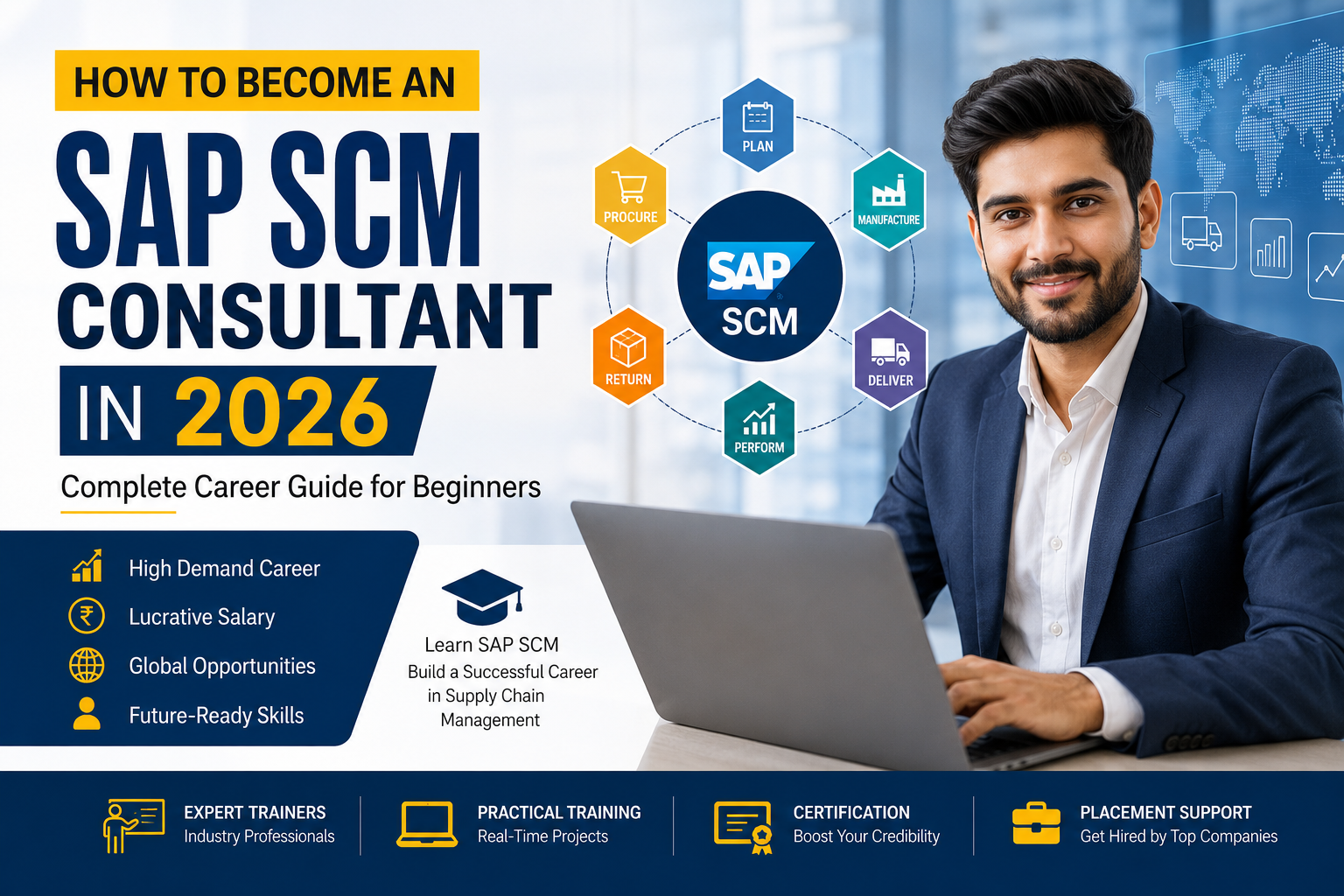
How to Become an SAP SCM Consultant in 2026: Complete Career Guide for Beginners
The demand for skilled SAP Supply Chain Management (SAP SCM) professionals continues to rise as organizations invest in intelligent supply chain solutions to improve efficiency, reduce operational costs, and enhance customer satisfaction. With businesses adopting digital transformation at an unprecedented pace, SAP SCM has become one of the most sought-after career paths for fresh graduates and experienced professionals. If you are planning to build a rewarding career in enterprise software, this guide explains everything you need to know about becoming an SAP SCM Consultant in 2026, including required skills, certification, career opportunities, salary expectations, training roadmap, and industry trends.
8 min read
Published Today
Web Development
What is SAP SCM?
End-to-end supply chain platform — SAP SCM helps organizations manage the complete supply chain, from planning and procurement to manufacturing, warehousing, logistics, and customer delivery. Optimizes inventory and forecasting — Improves inventory levels and demand forecasting accuracy. Streamlines procurement and warehousing — Enhances procurement processes and warehouse operations. Improves transportation and supplier collaboration — Manages transportation efficiently and strengthens supplier relationships. Reduces costs and boosts satisfaction — Reduces supply chain costs while increasing customer satisfaction. Widely adopted across sectors — Manufacturing, automotive, pharmaceuticals, retail, logistics, healthcare, FMCG, aerospace, and e-commerce all rely heavily on SAP SCM.
Why is SAP SCM One of the Most In-Demand Skills in 2026?
Digital transformation is reshaping operations — Companies are changing how they manage procurement, logistics, inventory, and production. Investment in intelligent supply chains — Organizations are adopting automation, analytics, AI, and cloud technologies. Configuration and optimization skills — Companies need professionals who can configure SAP SCM modules and optimize business processes. Implementation and integration support — Consultants support SAP implementations and perform system integration. Performance analysis — Professionals who can analyze supply chain performance are highly valued. S/4HANA migration expertise — Assisting with SAP S/4HANA migration projects is a critical, growing need. Competitive advantage — SAP SCM consultants help businesses remain competitive in today's global market.
Who Can Learn SAP SCM?
Broad eligibility — Fresh graduates, engineering students, MBA graduates, and B.Com/BBA graduates can all pursue SAP SCM. Relevant working professionals — Supply chain executives, procurement professionals, warehouse managers, and logistics coordinators benefit directly. Existing SAP and ERP backgrounds — Production planners, SAP end users, and ERP professionals can deepen their expertise. Career changers welcome — Working professionals seeking career growth can also enter this field. No coding required — No programming knowledge is needed to begin learning SAP SCM.
Essential Skills Required to Become an SAP SCM Consultant
Supply Chain Fundamentals — Understanding procurement, inventory management, production planning, warehouse operations, transportation, and demand planning. SAP Navigation — Learning the SAP interface, organizational structure, master data, and transaction processing. Business Process Analysis — Understanding how organizations operate and translating business requirements into SAP solutions. Problem-Solving — Identifying operational challenges and designing efficient SAP-based solutions. Communication Skills — Working effectively with business users, stakeholders, clients, and project teams. Analytical Thinking — Interpreting reports, KPIs, dashboards, and operational data to improve decision-making.
SAP SCM Modules You Should Learn
Core logistics modules — SAP MM (Materials Management), SAP PP (Production Planning), and SAP SD (Sales and Distribution). Warehouse and transportation modules — SAP WM (Warehouse Management), SAP EWM (Extended Warehouse Management), and SAP TM (Transportation Management). Planning and procurement platforms — SAP APO, SAP IBP, and SAP Ariba. Modern cloud supply chain — SAP S/4HANA Supply Chain. Employability boost — Learning these modules significantly improves employability.
Step-by-Step Roadmap to Become an SAP SCM Consultant in 2026
Step 1 – Learn Supply Chain Concepts — Start with inventory management, procurement, logistics, purchasing, and warehouse operations. Step 2 – Join Professional SAP SCM Training — Choose instructor-led training with live projects, real-time scenarios, and placement support. Step 3 – Practice Real-Time Business Scenarios — Build hands-on understanding of procurement cycles, purchase orders, inventory transfers, vendor management, and warehouse operations. Step 4 – Work on Live Projects — Practical implementation experience is highly valued by employers. Step 5 – Learn SAP S/4HANA — Most organizations are migrating to SAP S/4HANA, making it an essential skill for future consultants. Step 6 – Prepare for Certification — Certification validates your knowledge and improves your credibility during interviews. Step 7 – Build a Professional Resume — Highlight projects, business scenarios, certifications, and technical skills. Step 8 – Attend Mock Interviews — Practice SAP SCM interview questions to improve confidence and communication.
SAP SCM Course Syllabus
Foundations — ERP Fundamentals, Supply Chain Basics, Enterprise Structure, and Organizational Units. Master data — Master Data Management, Material Master, and Vendor Master. Procurement processes — Purchasing Process, Procurement Cycle, and Invoice Verification. Inventory operations — Inventory Management, Goods Receipt, Goods Issue, Batch Management, Physical Inventory, and Valuation. Planning and production — Material Requirement Planning (MRP) and Production Integration. Warehouse and modernization — Warehouse Management and SAP S/4HANA Overview. Applied learning — Reporting and Analytics, Real-Time Projects, Case Studies, and Interview Preparation.
SAP SCM Certification
Validates expertise — SAP certification demonstrates your expertise in enterprise supply chain solutions. Better job opportunities and pay — Leads to better job opportunities and higher salary packages. Global recognition — Offers global career recognition and increased employer confidence. MNC opportunities — Opens opportunities with multinational companies. Valuable for consulting roles — Especially valuable for professionals seeking roles in SAP implementation and consulting.
SAP SCM Career Opportunities
Core consulting roles — SAP SCM Consultant, SAP MM Consultant, and Procurement Consultant. Analytical roles — Inventory Analyst and Supply Chain Analyst. Functional and support roles — SAP Functional Consultant, SAP Support Consultant, and SAP Implementation Consultant. Specialized roles — Warehouse Management Consultant and Logistics Consultant. Broader ERP roles — ERP Consultant and SAP Business Analyst.
SAP SCM Salary in India
Freshers — ₹4–7 LPA depending on skills and location. 2–5 Years — ₹7–14 LPA for early-career consultants. 5–10 Years — ₹14–22 LPA for experienced professionals. Senior Consultants — ₹22–35+ LPA for senior-level experts. Premium skills pay more — Professionals with expertise in SAP S/4HANA, SAP IBP, SAP EWM, and SAP TM often command higher compensation.
Industries Hiring SAP SCM Professionals
Manufacturing and Automotive — Core industries with heavy SAP SCM adoption. Retail and E-Commerce — Sectors that depend on efficient supply chain operations. Pharmaceuticals and Healthcare — Regulatory-driven supply chain requirements. FMCG and Logistics — Fast-moving sectors relying on optimized supply chains. Oil & Gas and Aerospace — Complex, large-scale supply chain operations. Electronics, Food Processing, Textile, Chemical, and Energy — Wide-ranging industrial demand for SAP SCM expertise.
Why Chennai is a Great Place to Learn SAP SCM
Leading IT and manufacturing hub — Chennai has emerged as one of India's leading IT and manufacturing hubs. Strong SAP demand — The city hosts global organizations, automotive companies, logistics providers, and consulting firms that regularly recruit SAP professionals. Growing ecosystem — A growing IT ecosystem creates ongoing career opportunities. MNC access and better prospects — Offers opportunities with multinational companies and better salary prospects. Placement and trainer access — Extensive placement opportunities and access to experienced SAP trainers.
Tips to Get Your First SAP SCM Job
Learn SAP S/4HANA — Stay current with the latest SAP finance and supply chain platform. Build practical project experience — Hands-on exposure strengthens your profile. Earn SAP certification — Validates knowledge to employers. Improve communication skills — Essential for consulting and client-facing roles. Practice interview questions — Build confidence for technical and HR rounds. Create a professional LinkedIn profile — Improves visibility to recruiters. Stay updated with new SAP releases — Keeps your knowledge current. Participate in SAP webinars and communities — Builds network and ongoing learning.
Why Choose ICLP Technologies for SAP SCM Training in Chennai?
Industry-experienced trainers — Learn from professionals with real-world SAP SCM expertise. Live instructor-led classes — Real-time projects and interactive sessions. S/4HANA-focused curriculum — Flexible online and classroom training aligned with current industry needs. Career support — Interview preparation sessions and resume-building assistance. Placement support — Hands-on case studies and dedicated placement assistance. Ongoing support — Lifetime learning support for continued growth.
Frequently Asked Questions
QIs SAP SCM a good career in 2026?
Yes. With increasing investments in digital supply chains and SAP S/4HANA, SAP SCM continues to offer excellent career opportunities across industries.
QCan freshers learn SAP SCM?
Absolutely. Fresh graduates can start with SAP SCM after learning the basics of supply chain management.
QIs coding required for SAP SCM?
No. SAP SCM is primarily a functional domain that focuses on business processes rather than software development.
QHow long does it take to learn SAP SCM?
Most professional training programs can be completed within 2 to 4 months, depending on the learning mode and schedule.
QWhat is the average SAP SCM salary in India?
Entry-level professionals generally earn between ₹4–7 LPA, while experienced consultants can earn significantly more based on expertise and project experience.
QWhich industries use SAP SCM?
Manufacturing, retail, healthcare, logistics, automotive, pharmaceuticals, FMCG, aerospace, and many other sectors use SAP SCM to manage their supply chain operations.
✨
Conclusion
SAP SCM remains one of the most promising career options for professionals looking to build expertise in enterprise resource planning and supply chain management. As organizations continue adopting intelligent technologies and SAP S/4HANA, the demand for skilled SAP SCM consultants is expected to grow further in 2026 and beyond. By developing strong business knowledge, gaining hands-on experience, working on real-world projects, and earning relevant certifications, you can position yourself for a successful and rewarding career in SAP consulting. If you're ready to begin your journey, enrolling in a structured SAP SCM training program with practical exposure and placement support can help you take the first step toward becoming a successful SAP SCM Consultant.