We are hiring passionate trainers to join our growing team! Share your expertise with aspiring professionals in a dynamic learning environment. Enjoy competitive compensation, flexible schedules, and rewarding teaching experiences. Whether you're a seasoned instructor or industry expert, we provide the platform to shape futures. Apply now to become part of our elite training team!
Featured Article
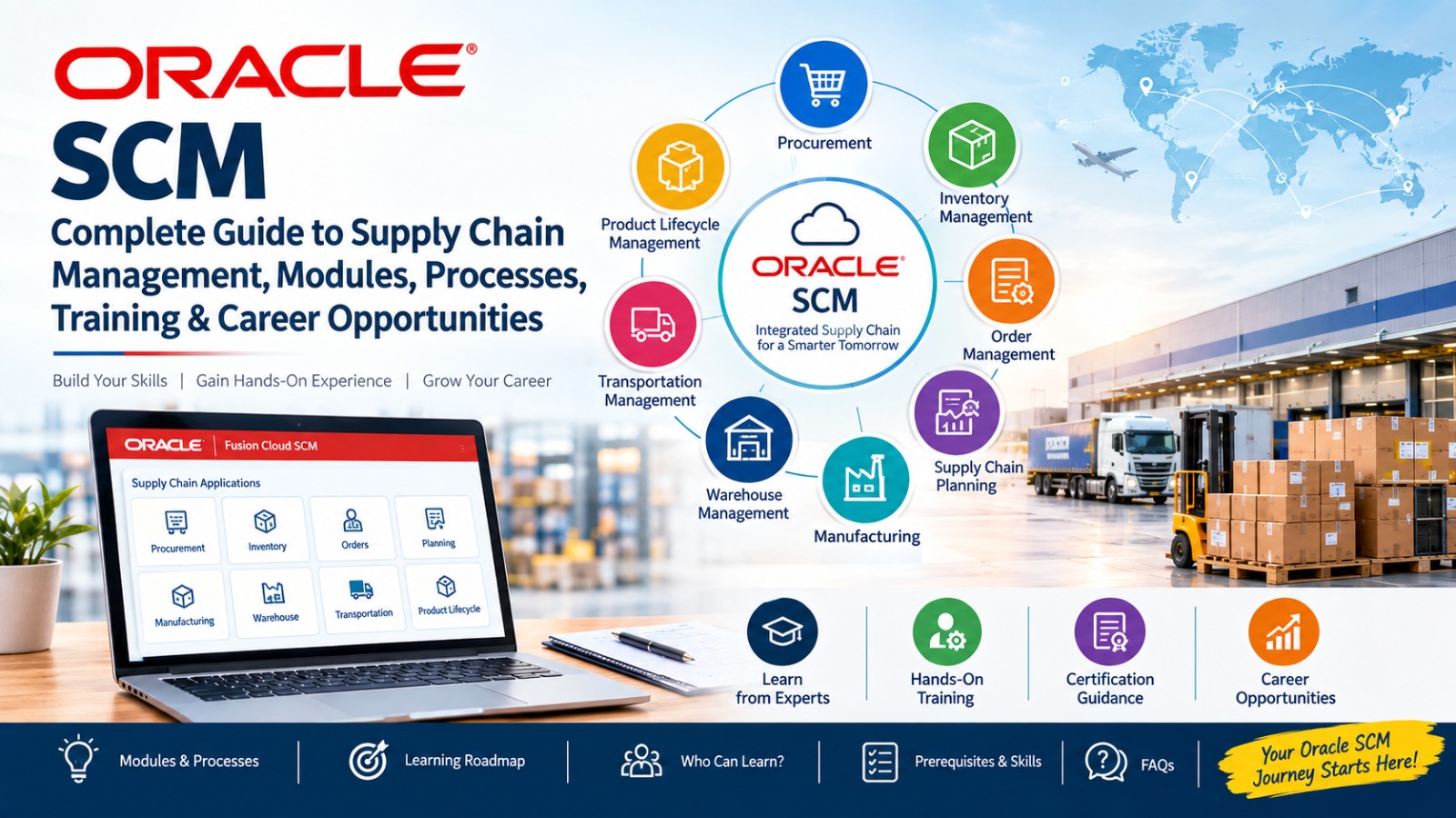
Oracle SCM: Complete Guide to Supply Chain Management, Modules, Processes, Training & Career Opportunities
Oracle Supply Chain Management (Oracle SCM) is a comprehensive suite of cloud-based applications designed to help organizations manage and optimize supply chain operations. From procurement and inventory management to order fulfillment, manufacturing, logistics, product lifecycle management, and supply chain planning, Oracle SCM brings multiple business processes together within an integrated technology environment. As organizations increasingly focus on digital supply chains, automation, real-time visibility, and efficient order fulfillment, knowledge of Oracle SCM, Oracle Fusion Cloud SCM, supply chain processes, and functional consulting can be valuable for professionals planning to build or expand their careers in enterprise technology. This complete guide explains what Oracle SCM is, its major modules, important business processes, prerequisites, who can learn Oracle SCM, hands-on training, certification, career opportunities, learning roadmap, interview preparation, FAQs, and more.
8 min read
Published Today
Web Development
What Is Oracle SCM
Definition — Oracle Supply Chain Management is a collection of applications organizations use to manage different parts of their supply chain. Scope of a modern supply chain — Procurement, suppliers, products, inventory, manufacturing, order management, logistics, warehouse operations, transportation, supply planning, demand planning, and product lifecycle management. The problem it solves — Managing these processes independently can create disconnected data and inefficient workflows; Oracle SCM provides an integrated environment to manage and connect many of these activities. Oracle Fusion Cloud SCM — Supports supply chain processes through cloud applications covering planning, procurement, manufacturing, inventory management, order management, logistics, and product lifecycle management. For professionals — Learning Oracle SCM means understanding both enterprise software functionality and real-world supply chain processes.
Why Is Oracle SCM Important
Growing complexity — Organizations may work with thousands of suppliers, products, customers, warehouses, manufacturing facilities, and distribution channels. Questions businesses must answer — What products and how much inventory are available, when to purchase materials, which suppliers to use, how to fulfill orders, where to store inventory, how to balance supply and demand, how to plan manufacturing, how to monitor delivery, and how to manage disruptions. Integrated platform — Oracle SCM provides applications and processes that help manage these activities together. Industries — Manufacturing, retail, e-commerce, healthcare, automotive, consumer goods, electronics, pharmaceuticals, logistics, distribution, high technology, and industrial organizations.
Oracle SCM and Oracle Fusion Cloud SCM
Cloud suite — Oracle Fusion Cloud SCM connects supply-chain processes across procurement, planning, manufacturing, inventory, order management, logistics, and related functions. An ecosystem, not one module — Oracle SCM is a set of interconnected applications; a professional may specialize in one area while understanding how it integrates with others. Example flow — Procurement → Receiving → Inventory → Order Management → Shipping → Customer Fulfillment. Why it matters — Understanding these connections is important for functional consultants.
Major Oracle SCM Modules
Implementation-dependent — The exact applications and capabilities used depend on the organization's business requirements and Oracle implementation. Oracle Procurement — Supports purchasing and supplier processes including supplier management, requisitions, purchase orders, approvals, receiving, contracts, supplier qualification, and spend management (Requirement → Requisition → Approval → Purchase Order → Supplier → Receipt → Invoice). Oracle Inventory Management — Supports inventory across warehouses and organizations, covering inventory organizations, subinventories, locators, items, on-hand quantity, material transactions, transfers, receipts, reservations, cycle counting, and physical inventory. Oracle Order Management — Manages customer orders and fulfillment, including sales orders, order capture, orchestration, scheduling, fulfillment, shipping, returns, and status management (Customer Order → Validation → Scheduling → Fulfillment → Picking → Shipping → Invoicing). Oracle Supply Chain Planning — Covers demand, supply, replenishment, sales and operations, production, and inventory planning to balance expected demand with available supply and resources. Oracle Manufacturing — Supports production orders, work definitions, work centers, materials, components, resources, production execution, completion, and material consumption, connected to inventory, procurement, planning, and fulfillment. Oracle Product Lifecycle Management — Manages product information through the lifecycle, including development, product structures, item management, change management, introduction, and compliance; accurate data is needed by procurement, inventory, manufacturing, and fulfillment. Oracle Warehouse Management — Covers receiving, putaway, picking, packing, replenishment, inventory movement, shipping, cycle counting, and warehouse task management. Oracle Transportation Management — Covers transportation planning, shipment execution, carrier management, freight, routing, delivery, and visibility. Other areas — Oracle Maintenance and Oracle Global Trade Management.
Oracle SCM End-to-End Process
Overall flow — Plan → Procure → Receive → Store → Manufacture → Fulfill → Ship → Deliver. Step 1: Planning — The organization forecasts demand and determines supply requirements. Step 2: Procurement — Required materials are purchased from suppliers. Step 3: Receiving — Materials arrive and are received. Step 4: Inventory — Received materials are stored and managed. Step 5: Manufacturing — Materials may be consumed during production. Step 6: Order Management — Customer orders are captured and processed. Step 7: Fulfillment — Products are allocated and prepared for fulfillment. Step 8: Shipping — Products are picked, packed, and shipped. Step 9: Delivery — Products reach the customer through the relevant logistics process. Why it matters — End-to-end understanding is extremely important for Oracle SCM functional consultants.
Oracle SCM Integration
Procurement + Inventory — Purchased materials are received and added to inventory. Inventory + Order Management — Available inventory can be used to fulfill customer orders. Order Management + Shipping — Customer orders trigger fulfillment and shipping processes. Planning + Procurement — Supply planning can identify material requirements that lead to procurement. Planning + Manufacturing — Production planning can influence manufacturing requirements. Product Management + Manufacturing — Product and item information is used in manufacturing processes. Value — Understanding integration makes it easier to troubleshoot issues and analyze requirements during implementation projects.
Who Can Learn Oracle SCM
Fresh Graduates — Those interested in ERP, supply chain, consulting, and enterprise applications can start with fundamentals. Supply Chain Professionals — People in procurement, inventory, logistics, planning, or warehouse operations can develop enterprise-software skills. SAP Professionals — Those wanting to understand another major enterprise technology ecosystem. ERP Professionals — Professionals already working with ERP systems can expand their functional knowledge. Business Analysts — Can learn how supply-chain processes are represented in enterprise applications. IT Professionals — Those interested in enterprise applications and cloud ERP can learn Oracle SCM from a functional perspective. Career Changers — Can begin with supply-chain fundamentals before progressing into Oracle SCM.
Oracle SCM Prerequisites
No advanced technical skills required — You do not necessarily need advanced technical skills to begin. Basic supply chain knowledge — Procurement, inventory, warehousing, logistics, manufacturing, and order fulfillment. ERP fundamentals — Helps you understand how business functions interact. Business process knowledge — Particularly useful for functional consulting. Basic computer skills — General computer and application skills are sufficient for beginners. Technical knowledge — Programming is not always required for functional roles, but technical concepts help when working with integrations, reports, interfaces, data, or technical teams.
Oracle SCM Hands-On Training
Why hands-on matters — Definitions build theory, but hands-on exercises show how the system behaves in actual business scenarios. Scenario 1: Procure-to-Receive — Create a procurement requirement, process the purchase order, receive materials, and verify inventory. Scenario 2: Inventory Transfer — Move inventory between appropriate locations and analyze the transaction. Scenario 3: Order-to-Ship — Create and process a customer order through fulfillment and shipping. Scenario 4: Inventory Management — Work with on-hand inventory, reservations, transactions, and counting processes. Scenario 5: Supply Planning — Understand how demand and supply information can influence planning decisions. Scenario 6: Manufacturing — Explore the relationship between materials, production, inventory, and fulfillment. Scenario 7: End-to-End SCM — Connect multiple modules in a complete business scenario.
Oracle SCM Learning Roadmap
Step 1: Learn Supply Chain Fundamentals — Procurement, inventory, warehousing, manufacturing, logistics, and order fulfillment. Step 2: Understand Oracle Fusion Cloud — Cloud concepts, enterprise structures, navigation, common terminology, and application architecture. Step 3: Choose a Functional Specialization — Procurement, Inventory, Order Management, Supply Chain Planning, Manufacturing, Warehouse Management, or Product Management. Step 4: Learn Core Business Processes — Understand end-to-end scenarios instead of isolated features. Step 5: Learn Configuration Concepts — Move from business processes into functional setup and configuration. Step 6: Learn Integration — Understand how modules exchange information and work together. Step 7: Practice Real-World Scenarios — Work on business cases involving procurement, inventory, orders, planning, and fulfillment. Step 8: Prepare for Interviews — Practice explaining business processes, functional configurations, integration, troubleshooting, and real-world scenarios. Step 9: Explore Certification — Review current Oracle certification options and identify the one relevant to your specialization.
Oracle SCM Certification
Purpose — Certification is a structured way to validate knowledge of Oracle applications. Verify current details — Availability, exam names, versions, and requirements can change, so check Oracle's official certification resources before registering. Beyond memorizing — Understand business processes, application functionality, configuration concepts, integration, real-world scenarios, and troubleshooting. Best combination — Certification preparation plus hands-on practice plus business-process understanding gives a more complete learning experience.
Oracle SCM Career Opportunities
Oracle SCM Functional Consultant — Translates business requirements into application functionality through requirement gathering, process analysis, configuration, testing, documentation, user support, and issue analysis. Oracle SCM Implementation Consultant — Participates in requirement analysis, solution design, configuration, testing, data activities, user training, and go-live support. Oracle SCM Support Consultant — Helps organizations resolve application and process-related issues. Module-focused roles — Oracle Procurement Consultant, Oracle Inventory Consultant, Oracle Order Management Consultant, Oracle Supply Chain Planning Consultant, and Oracle Manufacturing Consultant. Varies by organization — The exact role depends on the organization, implementation model, Oracle products used, and level of experience.
Skills Needed for an Oracle SCM Consultant
Business Process Understanding — Know how procurement, inventory, planning, manufacturing, and fulfillment work in real organizations. Functional Configuration — Translate business requirements into application settings. Analytical Thinking — Investigate why a business process is not working as expected. Communication — Regularly work with business users, project managers, developers, technical consultants, testing teams, and management. Documentation — Prepare requirement documents, functional specifications, test scenarios, process documents, and user guides. Testing — Understand functional testing, integration testing, and user acceptance testing. Problem Solving — Real projects frequently involve exceptions and unexpected business scenarios.
Oracle SCM Interview Preparation
Common areas — What is Oracle SCM and Fusion Cloud SCM, modules, procurement lifecycle, inventory organizations and transactions, order management, supply planning, manufacturing, warehouse processes, integration, configuration, testing, troubleshooting, and real-world scenarios. Explain processes — Prepare to explain how a complete business process works instead of memorizing definitions. Example questions — How does a procurement transaction affect inventory? How does a customer order move through fulfillment and shipping? How can supply planning influence procurement and manufacturing? Scenario-based preparation — Helps candidates communicate their functional understanding more effectively.
Benefits of Learning Oracle SCM
Build Supply Chain Knowledge — Understand how modern supply chains operate. Learn Enterprise Cloud Applications — Gain exposure to cloud-based enterprise applications. Develop Functional Consulting Skills — Learn requirement analysis, configuration, testing, and business-process mapping. Understand End-to-End Processes — See how procurement, inventory, planning, manufacturing, and fulfillment connect. Expand Professional Skills — Complements experience in supply chain, ERP, logistics, procurement, or IT. Gain Practical Knowledge — Hands-on exercises move learners beyond theoretical concepts.
Oracle SCM Training with Hands-On Practical Learning
Combine theory and practice — Look for a curriculum that pairs theory with practical application. What a comprehensive program includes — Oracle SCM fundamentals, Fusion Cloud concepts, Procurement, Inventory Management, Order Management, Supply Chain Planning, Manufacturing, Product Management, Warehouse Management, integration, and configuration concepts. Career-readiness elements — Real-world business scenarios, hands-on exercises, project guidance, interview preparation, and resume guidance. Objective — Learners should understand not only what Oracle SCM does, but also how supply-chain processes work inside the application.
Frequently Asked Questions
QWhat is Oracle SCM?
Oracle SCM is Oracle's suite of supply-chain applications used to manage processes such as procurement, inventory, order management, supply planning, manufacturing, logistics, and related operations.
QWhat is Oracle Fusion Cloud SCM?
Oracle Fusion Cloud SCM is Oracle's cloud-based supply-chain application suite designed to connect multiple supply-chain functions through an integrated cloud platform.
QIs Oracle SCM difficult to learn?
Oracle SCM contains several functional areas, so beginners should learn the concepts progressively. Starting with supply-chain fundamentals makes the learning process easier.
QWho can learn Oracle SCM?
Fresh graduates, supply-chain professionals, procurement professionals, logistics professionals, ERP professionals, business analysts, IT professionals, and career changers can learn Oracle SCM.
QIs coding required for Oracle SCM?
Coding is not generally the primary requirement for functional Oracle SCM roles. Functional consultants focus heavily on business processes, application functionality, configuration, testing, and requirements. Technical skills can become useful for integrations and technical collaboration.
QWhat are the major Oracle SCM modules?
Major areas include procurement, inventory management, order management, supply chain planning, manufacturing, product lifecycle management, warehouse management, transportation management, and related logistics capabilities.
QIs Oracle SCM useful for supply-chain professionals?
Yes. Oracle SCM can help supply-chain professionals understand how procurement, inventory, planning, manufacturing, and fulfillment processes are managed through enterprise software.
QIs hands-on training important?
Yes. Practical exercises help learners understand how business processes are executed and connected within the Oracle environment.
QCan freshers learn Oracle SCM?
Yes. Freshers can begin with supply-chain fundamentals and gradually progress into Oracle Fusion Cloud SCM, functional processes, configuration concepts, and practical scenarios.
QWhat is an Oracle SCM functional consultant?
An Oracle SCM functional consultant typically works with business users to understand requirements, configure application functionality, support testing, analyze issues, document processes, and assist with implementations or support activities.
QWhat should I learn before Oracle SCM?
Basic knowledge of supply chain, procurement, inventory, logistics, ERP concepts, and business processes can be helpful. Advanced programming knowledge is not necessarily required for functional learning.
QDoes Oracle SCM include procurement and inventory?
Yes. Procurement and inventory are important functional areas within Oracle's supply-chain application ecosystem.
QCan Oracle SCM knowledge help with a consulting career?
Oracle SCM knowledge can be relevant to functional consulting, implementation, support, business analysis, and other enterprise application roles. Career requirements vary by employer and project.
✨
Conclusion
Oracle SCM is a broad enterprise application area that connects multiple supply-chain functions, including procurement, inventory, order management, planning, manufacturing, product management, warehouse operations, transportation, and logistics. For beginners, the best approach is not to attempt every module simultaneously. A structured learning path can be: Supply Chain Fundamentals → Oracle Fusion Cloud Basics → Procurement → Inventory → Order Management → Planning → Manufacturing → Warehouse Management → Integration → Configuration → Hands-On Practice → Project Scenarios → Interview Preparation → Certification. Practical learning is particularly important for professionals who want to understand how Oracle SCM works in real business environments. By combining business-process knowledge, Oracle SCM application skills, hands-on practice, integration concepts, and consulting skills, learners can build a stronger foundation for roles within Oracle enterprise applications and supply-chain technology. ICLP Technologies provides structured learning support for professionals and learners who want to build knowledge of Oracle SCM and enterprise supply-chain processes.