We are hiring passionate trainers to join our growing team! Share your expertise with aspiring professionals in a dynamic learning environment. Enjoy competitive compensation, flexible schedules, and rewarding teaching experiences. Whether you're a seasoned instructor or industry expert, we provide the platform to shape futures. Apply now to become part of our elite training team!
Featured Article
Is Python Full Stack Development a Future-Ready Career in the Age of AI?
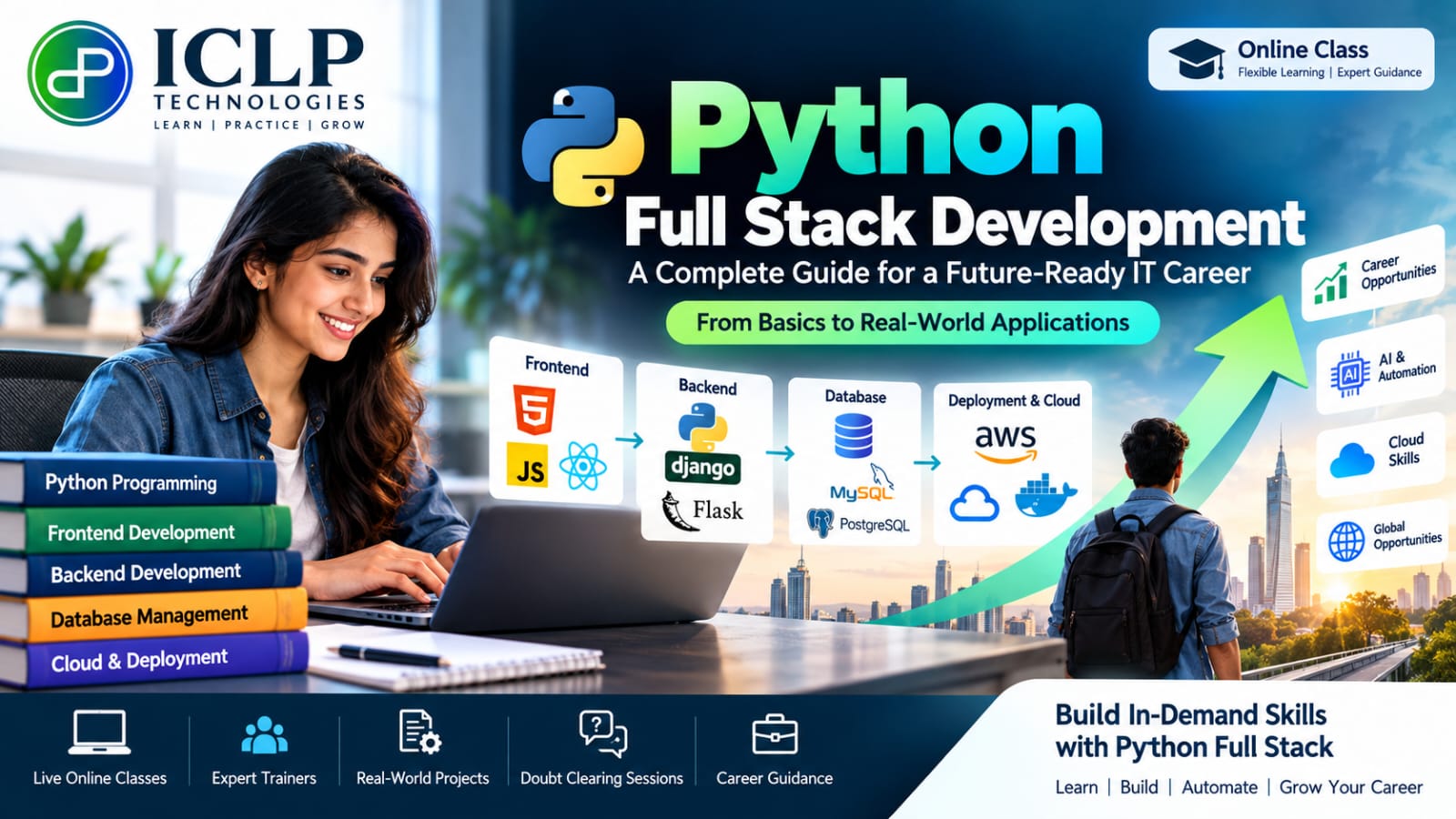
Many learners who want to enter the IT industry ask the same question: which course should I choose? Python, Java, Data Science, Artificial Intelligence, Cloud Computing, Software Testing, and Full Stack Development all promise opportunities. But the question that matters is not which course is trending today. It is which skills you can build, demonstrate, and continue improving in the coming years. With AI tools becoming more capable, another question follows naturally: will learning Python still be useful when AI can generate code? Python Full Stack Development is worth considering if you want to understand how complete web applications are built, from the interface people use to the backend logic and database behind it. Python is also widely used in automation, data work, and AI-related development, giving learners several possible directions for further study. At ICLP Technologies, learners can enquire about online training and explore whether this path matches their goals.
8 min read
Published Today
Web Development
What Is Python Full Stack Development
Everyday example — When you register for an online course, book an appointment, or shop through a website, frontend code displays information, backend code processes requests, and a database stores and retrieves data. Frontend development — HTML, CSS, and JavaScript create the interface users see. React may be added for interactive applications. Backend development — Python handles application logic. Frameworks such as Django, Flask, or FastAPI help developers build web applications and APIs. Databases — SQL databases such as PostgreSQL or MySQL store structured application data. Developers learn queries, relationships, and data handling. APIs, testing, and deployment — REST APIs connect application components, testing checks expected behaviour, Git supports version control, and deployment makes an application available to users. The role — A Python Full Stack Developer works across these connected layers. The exact stack depends on the course syllabus and the type of applications being built.
Why Consider Python Full Stack Development
Beginner-friendly starting point — Python syntax is often approachable for new programmers, although software development still requires consistent practice. Build complete applications — Learn how a frontend, backend, API, and database work together. Transferable skills — Practise problem-solving, debugging, testing, data handling, and software design. Several directions for further learning — Python skills can support additional study in backend development, automation, data analysis, or AI integration. Portfolio potential — Projects help you demonstrate what you can build rather than relying only on a certificate. Important note — Completing a course does not guarantee a job. Your projects, technical understanding, interview preparation, communication, and problem-solving ability all matter.
Python Full Stack vs Other IT Courses
No single best course — Choose based on the kind of work you want to do. Python Full Stack — Suits learners who want to build complete web applications and explore Python-based development. Focus: Python, Django/Flask/FastAPI, frontend, SQL, and APIs. Java Full Stack — Suits learners who want to build web applications, including many enterprise backend systems. Focus: Java, Spring Boot, frontend, SQL, and APIs. Data Science — Suits learners who want to analyse data and build statistical or predictive models. Focus: Python, statistics, data analysis, and machine learning. Cloud Computing — Suits learners who want to work with cloud infrastructure, deployment, and reliability. Focus: cloud platforms, networking, and operations. Software Testing — Suits learners who want to check software quality and identify defects. Focus: test design, manual testing, and automation. AI / Machine Learning — Suits learners who want to build or work with intelligent systems. Focus: data, programming, models, evaluation, and mathematics. Where Python Full Stack fits — It may be a strong fit if you want to build applications and also keep the option open to explore automation or AI integration. Java Full Stack may suit learners more interested in Java-based backend ecosystems, while Data Science and AI/ML may require stronger statistics or mathematics. Cloud and testing can complement either development path. How to decide — Do not choose based on a claim that one course is universally better. Compare the syllabus, projects, teaching support, your interests, and the skills demanded in the roles you want.
Will AI Replace Python Developers
What AI tools do — They can generate code, explain errors, suggest tests, and speed up repetitive tasks. That does not make programming knowledge pointless, but learners should aim beyond copying generated code. A practical example — If you ask an AI tool to create a login page, a page that looks correct is not necessarily secure or reliable. Can you verify password handling, backend validation, database queries, permissions, error handling, and behaviour when something goes wrong? Engineering skills that matter — As AI tools evolve, developers can benefit from learning how to review generated code, protect user data, test behaviour, integrate APIs, and make sound design decisions. Honest outlook — No course can guarantee that a particular job will remain unchanged. A stronger strategy is to build solid fundamentals, use AI responsibly, and keep updating your skills.
Skills to Build for an AI-Enabled Future
Python fundamentals — Data structures, functions, and object-oriented programming. Backend framework — Django, Flask, or FastAPI. Learn at least one framework thoroughly. Frontend skills — HTML, CSS, JavaScript, and optionally React. Databases — SQL, database design, and ORM concepts. APIs and security — REST APIs, authentication, authorisation, and application security. Engineering practices — Git, testing, debugging, and deployment. AI-assisted coding — Use AI tools with independent review and verification.
Projects That Make Your Skills Visible
The right question — Instead of asking only what certificate you will receive, ask what you can build independently by the end of the course. Course registration portal — Course listings, student registration, authentication, and admin functions. E-commerce application — Product listings, cart, order flow, and database operations. Expense tracker — Transactions, categories, reports, and data visualisation. Appointment booking system — Available time slots, bookings, cancellation, and user notifications. AI-enabled FAQ assistant — A web interface connected to an API, with clear limits, validation, and safe handling of user input. How to build — Start with a small project, then add validation, security, tests, documentation, and deployment. Only describe projects and technologies on your resume that you can explain and demonstrate.
Career Paths to Explore
Entry-level directions — Junior Python Developer, Python Backend Developer, Entry-Level Full Stack Developer, Software Developer Trainee, Application Developer, and Junior Automation Developer. Role requirements — Some roles require extra experience or specialisation. Review job descriptions to understand their actual requirements. Long-term growth — Over time, further learning may open pathways into backend engineering, cloud development, data engineering, or AI-integrated applications.
What Should You Ask Before Enrolling
Syllabus — Does it include Python fundamentals, SQL, a web framework, APIs, and frontend basics? Projects — Will you build projects from the beginning and receive feedback? Support — Are live online classes, doubt-clearing sessions, and trainer support available? Professional practices — Does the course cover Git, testing, security, and deployment? Career preparation — Will you receive interview preparation and portfolio guidance? Placement support — Are placement support details clear and verifiable? Transparency — Are the fees, schedule, course duration, and refund terms clearly explained? What good looks like — A good course should help you build skills you can demonstrate independently, not simply complete videos or collect certificates.
Learn Python Full Stack Online with ICLP Technologies
Who it suits — If you are a fresher, a graduate exploring IT, or a learner who wants to develop programming skills, Python Full Stack Development may be a useful starting point. What to ask — Before enrolling, ask the team about the current syllabus, online class format, trainer support, projects, duration, fees, and any placement assistance available. Hands-on practice — Confirm that the course includes enough practice for you to build and explain applications independently. Next step — Contact ICLP Technologies to enquire about Python Full Stack Development online classes and the current course details.
Frequently Asked Questions
QIs Python Full Stack Development good for beginners?
It can be. Start with Python basics and gradually learn databases, frontend development, a backend framework, APIs, and projects. Regular practice is essential.
QCan a non-IT graduate learn Python Full Stack?
Yes. Learners from non-IT backgrounds can develop these skills, but progress depends on practice, support, and the time invested.
QIs Python better than Java?
Neither is universally better. Python is common in automation, data and AI ecosystems as well as backend development. Java is widely used in backend and enterprise systems. Choose based on your interests and target roles.
QWill AI reduce Python developer opportunities?
AI may automate some coding tasks and change developer workflows. The effect on future hiring is uncertain. Understanding fundamentals, security, testing, and system design helps developers adapt.
QHow long does it take to learn Python Full Stack?
It depends on your starting point, class schedule, practice time, and project complexity. Ask the provider for a syllabus-based timeline and realistic practice expectations.
QCan I get a job after a Python Full Stack course?
A course can help you build relevant skills, but employment is not guaranteed. Employers may assess projects, coding, problem-solving, communication, and interview performance.
QWhat is the difference between Python and Python Full Stack?
Python is a programming language. Python Full Stack combines Python backend development with frontend technologies, databases, APIs, and related tools.
QCan Python Full Stack lead to AI-related work?
It can provide a useful application-development foundation. AI-focused roles may require additional learning in data, machine learning, model evaluation, or AI APIs.
✨
Conclusion
Your future is not built by choosing a trending course. It is built by developing skills you can prove. Python Full Stack Development offers a structured way to learn how complete web applications are built, from HTML and JavaScript interfaces to Python backends, databases, APIs, testing, and deployment. As AI tools evolve, solid fundamentals, security awareness, and the ability to review and verify code will remain valuable. Ready to explore Python Full Stack Development? Contact ICLP Technologies to enquire about online classes, review the current syllabus, and choose a learning path aligned with your goals.