We are hiring passionate trainers to join our growing team! Share your expertise with aspiring professionals in a dynamic learning environment. Enjoy competitive compensation, flexible schedules, and rewarding teaching experiences. Whether you're a seasoned instructor or industry expert, we provide the platform to shape futures. Apply now to become part of our elite training team!
Featured Article
SAP EWM Explained: Complete Guide to Extended Warehouse Management, Processes, Skills & Career Opportunities
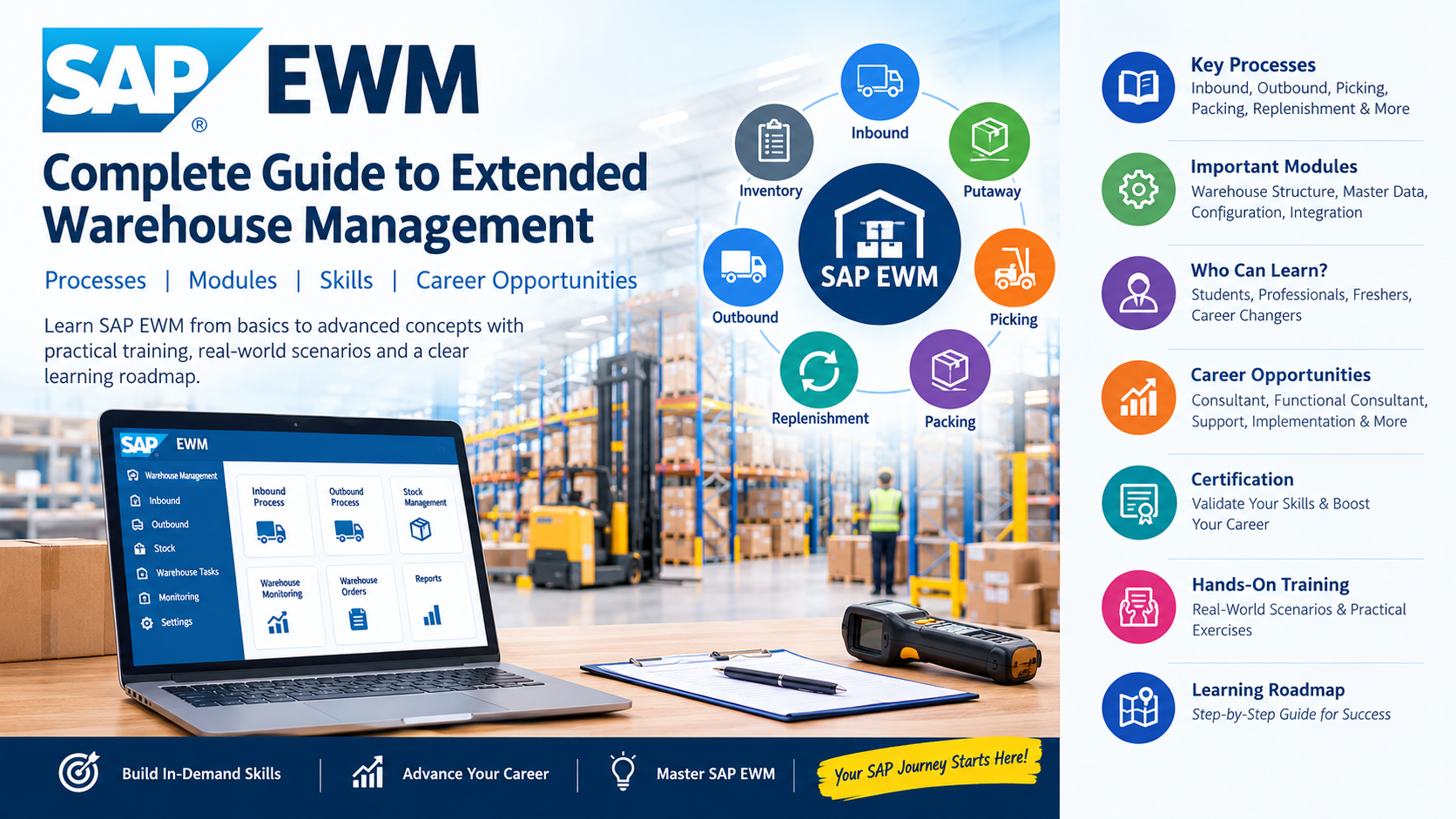
SAP Extended Warehouse Management (SAP EWM) is a warehouse management solution designed to help organizations manage complex warehouse operations, inventory, goods movements, fulfillment, and logistics processes with greater visibility and control. Modern warehouses handle large volumes of products, multiple storage locations, inbound and outbound deliveries, picking, packing, replenishment, inventory counting, and increasingly automated operations. SAP EWM provides functionality for managing these processes at a detailed warehouse level, including storage-bin-level inventory visibility and warehouse process control. As businesses continue to invest in digital supply chains, professionals with knowledge of SAP EWM, warehouse management, SAP S/4HANA, inventory processes, and logistics integration can build valuable skills for careers in SAP consulting and supply-chain technology. This guide explains what SAP EWM is, how it works, its important modules and processes, prerequisites, who can learn SAP EWM, hands-on training, certification, career opportunities, and a practical learning roadmap.
8 min read
Published Today
Web Development
What Is SAP EWM
Purpose — An SAP solution used to manage and control warehouse operations, integrating warehouse and distribution processes with broader supply-chain activities. Beyond basic inventory management — Unlike basic inventory management, which focuses on stock quantities and values, EWM provides detailed warehouse-level visibility, representing warehouse structures down to storage-bin level. Current capabilities — Warehouse management, inbound and outbound processing, stock transparency, automation integration, slotting, yard-related processes, and other advanced warehouse functions. Deployment — Can be deployed with SAP S/4HANA in different configurations or as a standalone solution, depending on the business and system landscape. Questions it answers — What stock is available and where it is stored, which products have arrived, where incoming goods should be put away, what needs to be picked, how products are packed and shipped, when stock should be replenished, and how resources and inventory movements can be monitored.
Why Is SAP EWM Important
Growing warehouse complexity — High-volume inventory, multiple products and variants, faster order fulfillment, e-commerce operations, multiple warehouses, automation and robotics, real-time inventory needs, batch and serial number tracking, returns, cross-docking, production supply, and transportation integration. For organizations — A centralized warehouse management environment with stock and process transparency, warehouse space utilization, automation, slotting, and better visibility into warehouse activities. For professionals — A pathway into SAP consulting, warehouse management, supply-chain technology, logistics, implementation, support, and business process analysis.
SAP EWM vs Traditional Warehouse Management
Traditional SAP WM — Focuses on essential warehouse functions such as inventory movement, storage, picking, and putaway. SAP EWM — Expands capabilities for more complex environments, including detailed warehouse structures, storage-bin-level inventory, warehouse task and order management, wave management, replenishment, storage control, physical inventory, labor and resource optimization, yard processes, cross-docking, value-added services, and automation integration. Advanced scenarios — Includes material-flow control, yard management, labor management, value-added services, kitting, cross-docking, and warehouse robotics. In practice — Professionals working with complex warehouse environments may encounter EWM as part of broader SAP S/4HANA supply-chain implementations.
SAP EWM Architecture and Deployment
Decentralized EWM — Historically available as a decentralized warehouse management solution. Embedded EWM — With SAP S/4HANA, EWM can be implemented as embedded EWM, where warehouse management capabilities operate within the S/4HANA environment. Deciding factors — Business requirements, warehouse complexity, existing SAP landscape, integration requirements, system architecture, operational volume, and automation requirements. Two perspectives — Learners should understand both the business process perspective and the system integration perspective.
Key SAP EWM Processes
Inbound Process — Begins when goods arrive: inbound delivery creation, arrival of goods, goods receipt, unloading, inspection where applicable, putaway determination, warehouse task creation, and movement to the appropriate storage bin. Putaway Process — Determines where received products are stored using rules and strategies; covers storage types, sections, bins, putaway strategies, capacity checks, warehouse process types, and warehouse tasks. It is essential for EWM functional consultants because it directly affects warehouse efficiency. Internal Warehouse Processes — Stock transfers, replenishment, posting changes, bin-to-bin movements, physical inventory, and other internal movements, with visibility into stock and movements. Outbound Process — Outbound delivery, warehouse request, picking, warehouse task creation, picking confirmation, packing, staging, loading, goods issue, and shipment, with support for wave-based processing and optimized work packages. Picking — Removing products from warehouse locations to fulfill an order, using approaches such as single-order picking, wave picking, zone-based processes, pick-and-pack scenarios, voice-assisted processes, and mobile warehouse processes. Packing — Packaging-related processes and handling unit management, including packaging materials, packing stations, and packing specifications. Replenishment — Moving stock between locations to keep picking areas stocked; for example, the system can initiate replenishment when a picking location falls below a required quantity. Physical Inventory — Counting actual stock and comparing it with system records, including inventory documents, counting, difference handling, stock adjustments, cycle counting, and inventory monitoring.
SAP EWM Modules and Important Topics to Learn
SAP EWM Introduction — Introduction to warehouse management, EWM overview, architecture, deployment options, embedded and decentralized EWM, and basic terminology. Enterprise and Warehouse Structure — Warehouse number, storage type, storage section, storage bin, activity area, work center, doors, and staging areas, which represent the physical warehouse inside SAP. Master Data — Product master, business partners, packaging specifications, warehouse product data, storage-related master data, and handling units; without correct master data, warehouse processes cannot operate properly. Warehouse Process Types — Configuration, process determination, and how putaway, picking, internal movements, and replenishment are controlled. Warehouse Tasks — Activities executed in the warehouse such as putaway, picking, stock movement, replenishment, and internal transfer; a core EWM concept. Warehouse Orders — Groups of warehouse tasks organized into executable work packages, including order creation, task and resource assignment, work execution, and monitoring. Storage Control — Process-oriented and layout-oriented storage control for multi-step movements, including intermediate steps and process execution. Wave Management — Groups warehouse activities by criteria such as delivery, time, route, customer, product, or warehouse area to organize outbound work. Warehouse Monitoring — Monitoring warehouse tasks, stock, deliveries, warehouse orders, resources, exceptions, and process status, along with mobile-device processing.
SAP EWM Integration
SAP S/4HANA — EWM can operate with S/4HANA through embedded or decentralized architectures depending on the implementation scenario. SAP Inventory Management — Inventory-related processes are closely connected with warehouse execution. SAP Transportation Management — Transportation and warehouse processes can work together to support logistics execution. SAP Production — Supports material staging and warehouse processes for manufacturing, including delivery-based production supply and advanced production integration. SAP Quality Management — Quality-related processes can be integrated with warehouse activities. Automation — Modern EWM environments can integrate warehouse automation technologies, including robotics.
Who Can Learn SAP EWM
SAP professionals — SAP beginners, SAP MM, SD and WM professionals, ERP consultants, and functional consultants. Supply-chain and warehouse professionals — Supply-chain, logistics, inventory, and operations professionals and warehouse managers. Analysts and IT professionals — Business analysts, IT professionals, and professionals transitioning into SAP. Fresh graduates — Graduates can start with fundamentals and build toward practical scenarios. Background advantage — People with logistics or warehouse experience may find the business processes familiar, while SAP professionals can build additional specialization in supply-chain execution.
SAP EWM Prerequisites
No need to be an expert — There is no need to be an expert in every SAP module before starting SAP EWM. Basic SAP knowledge — Understanding basic SAP navigation and enterprise structures can be helpful. Supply chain knowledge — Basic knowledge of procurement, inventory, logistics, warehouse operations, and order fulfillment helps learners understand EWM processes. SAP MM knowledge — Particularly useful because warehouse and inventory processes interact with material management. SAP S/4HANA awareness — Helps learners understand modern EWM deployment scenarios. Process knowledge — Warehouse or logistics experience can be used to understand SAP EWM business scenarios. Beginner-friendly resources — SAP's own learning resources include beginner-level EWM content, including courses with no listed prerequisites.
SAP EWM Hands-On Training
Why hands-on matters — Theory alone may not be enough for an implementation or support role; hands-on training shows how warehouse processes actually work inside the SAP environment. Scenario 1: Inbound Delivery — Create an inbound process and see how received goods move through the warehouse. Scenario 2: Putaway — Configure or execute putaway-related processes and understand storage determination. Scenario 3: Outbound Delivery — Process an outbound order from delivery creation through picking, packing, staging, and goods issue. Scenario 4: Replenishment — Understand how stock is moved to maintain picking-area inventory. Scenario 5: Physical Inventory — Create and execute an inventory-counting scenario. Scenario 6: Warehouse Monitoring — Monitor warehouse tasks, stock, deliveries, and process status. Scenario 7: Production Integration — Understand how warehouse processes interact with production supply. Official resources — SAP's learning resources include hands-on practice and courses covering warehouse structures, inbound and outbound processes, storage control, warehouse orders, replenishment, physical inventory, and related configuration.
SAP EWM Learning Roadmap
Stage 1: Learn Warehouse Fundamentals — Warehouse terminology, inventory concepts, inbound and outbound processes, picking, packing, and putaway. Stage 2: Learn SAP EWM Fundamentals — EWM architecture, deployment options, warehouse structure, storage types, storage bins, activity areas, and work centers. Stage 3: Learn Master Data — Product master, business partners, packaging specifications, warehouse product data, and handling units. Stage 4: Learn Core EWM Processes — Inbound, putaway, outbound, picking, packing, replenishment, stock transfers, and physical inventory. Stage 5: Learn Configuration — Warehouse process types, process determination, putaway and stock removal strategies, storage control, warehouse orders, and wave management. Stage 6: Learn Integration — How EWM interacts with SAP S/4HANA, Inventory Management, Transportation, Production, and Quality Management. Stage 7: Practice Real-World Scenarios — Work through complete business scenarios rather than individual transactions in isolation. Stage 8: Prepare for Certification — Use current SAP learning resources and certification information to identify the relevant exam scope.
SAP EWM Certification
Complement practical skills — Certification can validate SAP knowledge but should be combined with practical understanding. Official resources — SAP provides learning journeys and certification preparation resources through SAP Learning. Preparation coverage — EWM fundamentals, warehouse structures, master data, inbound and outbound processing, storage control, warehouse tasks and orders, replenishment, physical inventory, integration, and configuration concepts. Verify current details — Certification names, exam versions, availability, and requirements can change, so verify current information directly with SAP before registering.
SAP EWM Career Opportunities
SAP EWM Consultant — Works on implementation, configuration, business requirements, testing, and support. SAP EWM Functional Consultant — Focuses on business processes, configuration, functional requirements, and system behavior. SAP EWM Support Consultant — Troubleshoots production issues and maintains existing warehouse processes. SAP EWM Implementation Consultant — Participates in requirement gathering, configuration, testing, documentation, and go-live activities. SAP Supply Chain Consultant — Works across supply-chain processes and may use EWM within a broader SAP SCM landscape. Warehouse Business Analyst — Uses warehouse and SAP knowledge to analyze business requirements and process improvements. SAP Logistics Consultant — Works across logistics processes and may integrate EWM with other SAP logistics solutions. Varies by organization — Responsibilities depend on the organization, project type, SAP version, industry, and level of experience.
Industries Using Warehouse Management Solutions
Potential industries — Manufacturing, automotive, retail, e-commerce, pharmaceuticals, consumer products, food and beverage, electronics, logistics, distribution, wholesale, and industrial equipment. Complexity decides scope — A high-volume distribution center may require advanced picking, wave management, automation, and warehouse monitoring, while another organization may have simpler requirements.
Skills to Develop Alongside SAP EWM
Technical and SAP skills — SAP S/4HANA fundamentals, SAP MM fundamentals, SAP configuration, testing, and integration concepts. Domain skills — Supply-chain management, warehouse operations, and business-process mapping. Consulting skills — Documentation, functional specification preparation, problem solving, and communication. Why it matters — Professionals who understand both SAP technology and actual warehouse business processes can better communicate with business users and project teams.
Common SAP EWM Interview Topics
Fundamentals — What is SAP EWM, SAP EWM vs SAP WM, and embedded vs decentralized EWM. Warehouse structure — Storage types, storage sections, storage bins, and activity areas. Core objects — Warehouse process types, warehouse tasks, warehouse orders, and handling units. Strategies and processes — Putaway and stock removal strategies, replenishment, wave management, storage control, inbound and outbound processes, and physical inventory. Integration and support — EWM integration, production integration, error handling, and warehouse monitoring. Complete processes — Hands-on practice helps most when interviewers ask candidates to explain an entire business process rather than define terminology.
Benefits of Learning SAP EWM
Understand Modern Warehouse Processes — Learn how warehouse operations can be represented and controlled through an enterprise system. Build SAP Supply-Chain Knowledge — EWM adds warehouse execution knowledge to a broader SAP skill set. Develop Functional Consulting Skills — Practice requirement analysis, configuration, testing, and business-process mapping. Gain Practical Knowledge — Hands-on scenarios connect theory with real warehouse processes. Expand Career Options — Relevant to consulting, implementation, support, logistics, and supply-chain technology roles. Understand Digital Warehousing — Modern EWM includes automation, real-time visibility, advanced warehouse processes, and integration with broader supply-chain operations.
SAP EWM Training: What Should a Good Course Include
Look beyond topic count — A comprehensive program should include SAP EWM fundamentals, warehouse organizational structure, master data, inbound process, putaway, outbound process, picking, packing, and replenishment. Core execution topics — Warehouse tasks, warehouse orders, storage control, wave management, physical inventory, and warehouse monitoring. Career-readiness topics — Integration, configuration, real-world scenarios, interview preparation, and project exposure. End-to-end practice — Most importantly, learners should get opportunities to practice complete scenarios.
Why Choose Hands-On SAP EWM Learning
The gap — Someone may understand the definition of putaway but still struggle to explain how storage locations are structured, how strategies work, how warehouse tasks and orders are created, how operators execute the activity, and how exceptions are handled. The learning path — Hands-on learning moves the learner from Concept → Configuration → Execution → Monitoring → Troubleshooting. Best suited for — Particularly useful for people preparing for functional consulting and support roles.
Frequently Asked Questions
QWhat is SAP EWM?
SAP EWM stands for SAP Extended Warehouse Management. It is an SAP warehouse management solution designed to manage detailed warehouse operations, inventory, goods movements, inbound and outbound processes, and other warehouse activities.
QIs SAP EWM difficult to learn?
SAP EWM contains many concepts, but learning becomes easier when the subject is studied progressively. Beginners should start with warehouse fundamentals before moving into configuration and advanced processes.
QWho can learn SAP EWM?
SAP professionals, logistics professionals, warehouse professionals, supply-chain professionals, graduates, business analysts, and IT professionals can learn SAP EWM.
QIs SAP MM knowledge required for SAP EWM?
SAP MM knowledge is not necessarily mandatory, but understanding inventory and material-management concepts can make EWM easier to learn.
QIs SAP EWM part of SAP S/4HANA?
SAP EWM can be deployed with SAP S/4HANA, including embedded EWM scenarios, and SAP also supports decentralized deployment options.
QWhat are the main SAP EWM processes?
Major processes include inbound processing, putaway, internal warehouse movements, picking, packing, replenishment, outbound processing, and physical inventory.
QWhat is the difference between SAP WM and SAP EWM?
SAP EWM provides expanded functionality for complex warehouse environments, including advanced warehouse processes, monitoring, storage control, resource optimization, automation-related capabilities, and other features.
QDoes SAP EWM require coding?
SAP EWM functional roles primarily focus on business processes and configuration. Technical requirements can vary by project and may involve integration, development, or enhancement work.
QIs hands-on practice important for SAP EWM?
Yes. Practical exercises help learners understand how warehouse processes operate in an SAP environment and can improve their ability to discuss real-world scenarios during interviews and projects.
QCan SAP EWM help with a career in supply chain?
SAP EWM knowledge can be relevant to careers involving warehouse management, logistics, SAP consulting, implementation, support, and supply-chain technology.
QCan freshers learn SAP EWM?
Yes. Freshers can start with SAP EWM fundamentals and gradually learn warehouse processes, configuration, integration, and practical scenarios.
QDoes SAP provide SAP EWM learning resources?
Yes. SAP Learning provides courses and learning journeys covering EWM fundamentals, processes, customization, integration, and certification preparation.
✨
Conclusion
SAP EWM is more than a warehouse inventory tool. It provides a structured way to manage warehouse processes, stock movements, storage locations, inbound and outbound operations, picking, packing, replenishment, physical inventory, monitoring, and integration with broader supply-chain processes. For learners, the most effective approach is to build knowledge progressively: Warehouse Fundamentals → SAP EWM Concepts → Warehouse Structure → Master Data → Inbound → Putaway → Outbound → Picking & Packing → Replenishment → Storage Control → Configuration → Integration → Hands-On Projects → Interview Preparation → Certification. Whether you are a fresher, SAP professional, warehouse specialist, logistics professional, or someone planning a transition into SAP supply-chain consulting, developing practical SAP EWM knowledge can help you understand one of the important technology areas within modern warehouse operations. At ICLP Technologies, learners can develop their understanding of SAP EWM through a practical learning approach covering fundamental concepts, warehouse processes, configuration concepts, real-world scenarios, hands-on practice, interview preparation, resume guidance, project support, and career guidance.