We are hiring passionate trainers to join our growing team! Share your expertise with aspiring professionals in a dynamic learning environment. Enjoy competitive compensation, flexible schedules, and rewarding teaching experiences. Whether you're a seasoned instructor or industry expert, we provide the platform to shape futures. Apply now to become part of our elite training team!
Featured Article
SAP FICO Course in Chennai: Syllabus, Career Opportunities and Learning Guide for 2026
Are you looking to build a career in accounting, finance, or enterprise resource planning? Learning SAP FICO can help you understand how businesses manage financial transactions, accounting records, cost control, and financial reporting through an integrated ERP system. Choosing the right SAP FICO Course in Chennai can help you develop practical knowledge of Financial Accounting (FI), Controlling (CO), and SAP S/4HANA Finance. Whether you are a commerce graduate, finance professional, accountant, MBA graduate, or working professional, understanding the course syllabus and career options is an important first step. In this guide, we explore SAP FICO fundamentals, important course modules, practical learning, career opportunities, and how to choose suitable SAP FICO classes in Chennai. At ICLP Technologies, learners can explore software training programs and career-oriented learning opportunities.
8 min read
Published Today
Web Development
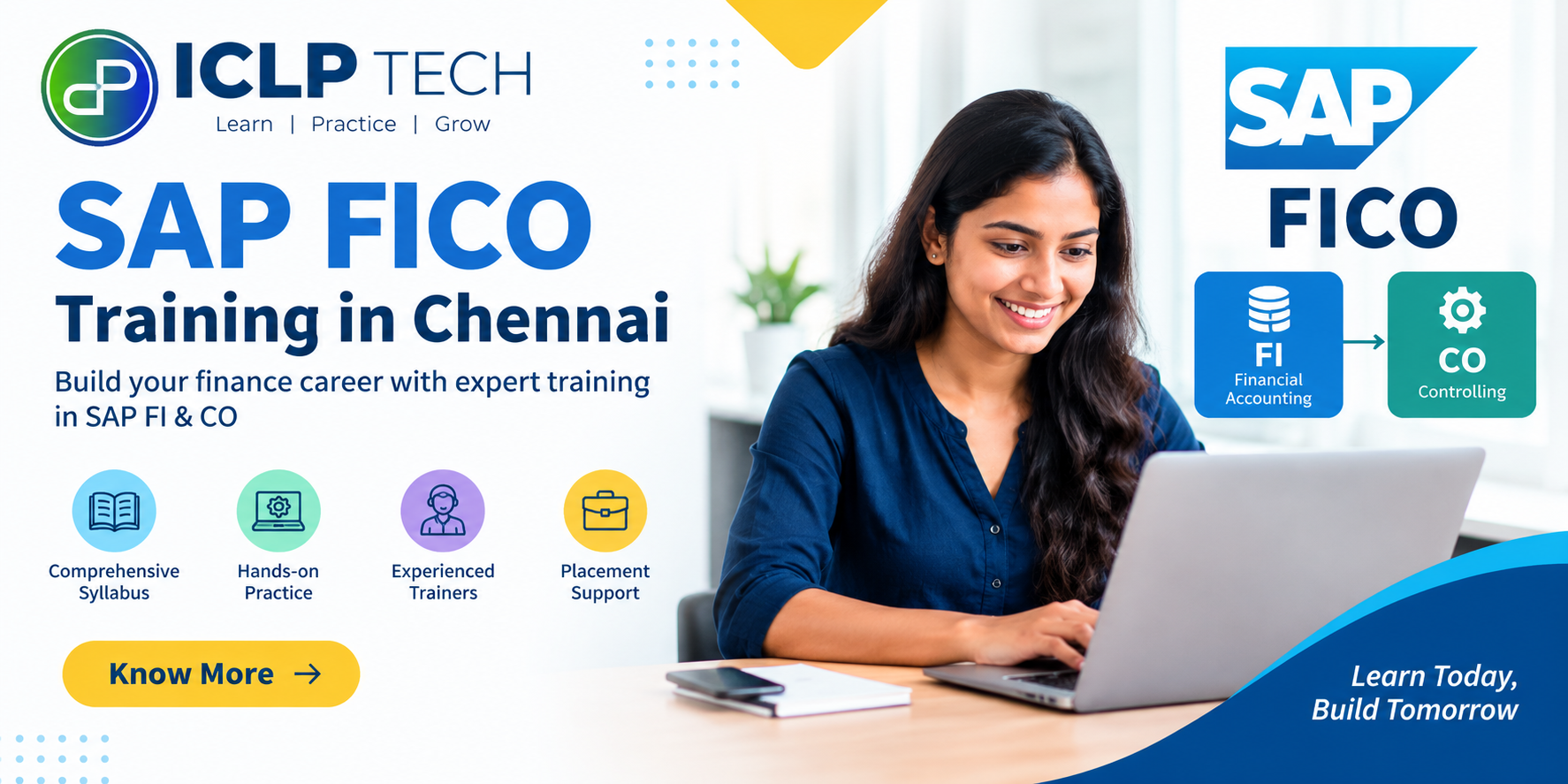
What Is SAP FICO
Definition — SAP FICO is a functional area of SAP ERP that combines Financial Accounting (FI) and Controlling (CO). Financial Accounting — Helps organizations maintain financial records and prepare reports for external reporting requirements. Controlling — Supports internal cost monitoring, budgeting, profitability analysis, and management reporting. Why it matters — Together, these functions help businesses maintain financial visibility and make informed operational decisions. FI topics — General Ledger Accounting, Accounts Payable, Accounts Receivable, Asset Accounting, Bank Accounting, financial statements and reporting, period-end and year-end closing activities, and tax-related configuration concepts. CO topics — Cost Centre Accounting, Internal Orders, Profit Centre Accounting, Product Costing, Profitability Analysis, cost planning and allocation, and management reporting. Scope note — The topics covered depend on the course level, SAP environment, and training curriculum.
Why Consider SAP FICO Training in Chennai
Business environment — Chennai has businesses across IT services, manufacturing, automotive, logistics, consulting, and other industries that use enterprise software to support financial and operational processes. Relevance — SAP FICO knowledge can be relevant to professionals who want to understand how finance processes work within an ERP environment. What a programme should do — A structured SAP FICO Training in Chennai programme should help learners understand accounting workflows, practise transactions, explore configuration concepts, and connect classroom knowledge with business scenarios. Before enrolling, check for — A structured FI and CO syllabus, practical access to an SAP training environment, SAP S/4HANA Finance concepts, business-process demonstrations, trainer support and doubt-clearing sessions, scenario-based exercises, and interview preparation and career guidance. Compare carefully — Compare the actual course contents and services instead of choosing a programme based only on promotional claims.
SAP FICO Course Syllabus: Important Topics to Learn
Learning roadmap — A comprehensive roadmap should progress from basic SAP navigation to financial accounting, controlling, integration, and practical business scenarios. 1. Introduction to SAP and ERP — Understand enterprise resource planning, SAP navigation, organisational structures, master data, and the role of SAP in business operations. 2. Enterprise Structure — Learn about company codes, charts of accounts, fiscal year variants, posting periods, and other organisational settings used in financial processes. 3. General Ledger Accounting — Understand journal entries, G/L master data, document posting, account balances, financial statement preparation, and closing procedures. 4. Accounts Payable and Accounts Receivable — Explore vendor invoices, customer invoices, incoming payments, outgoing payments, open-item management, and reconciliation processes. 5. Asset Accounting and Bank Accounting — Study fixed-asset records, depreciation concepts, bank transactions, and reconciliation workflows. 6. Controlling and Cost Management — Learn how organisations track expenses through cost centres, internal orders, profit centres, product costing, and profitability analysis. 7. Taxation and Financial Reporting — Understand the relevant tax configuration concepts covered in the course, financial reporting, and period-end activities. The specific topics depend on the SAP version and curriculum. 8. SAP S/4HANA Finance — Explore relevant S/4HANA Finance concepts, including the Universal Journal, Business Partner approach where applicable, and modern financial reporting capabilities. 9. Integration with Other SAP Modules — Understand how finance processes connect with materials management (MM), sales and distribution (SD), procurement, inventory, and sales transactions. 10. Practical Business Scenarios — Practise complete workflows such as vendor invoice posting, customer payment processing, asset depreciation, cost allocation, and financial closing. Why practice matters — Practical exercises help learners understand not just which transactions to perform, but why a business performs them.
SAP ECC FICO vs SAP S/4HANA Finance
ERP environment — SAP ECC FICO runs on the earlier SAP ERP platform, while S/4HANA Finance runs on SAP's newer ERP platform. Financial data — ECC uses traditional ERP data structures, while S/4HANA uses a simplified data model with the Universal Journal. Reporting — ECC offers traditional reporting capabilities, while S/4HANA offers modernised reporting and analytics capabilities. Learning focus — ECC focuses on core FI and CO processes, while S/4HANA covers core processes plus relevant S/4HANA concepts. Choosing a path — The appropriate learning path depends on your current knowledge, the SAP systems used by your target employers, and your career goals.
Who Can Join SAP FICO Classes in Chennai
Commerce and management graduates — B.Com, M.Com, BBA, and MBA Finance graduates. Finance professionals — Accountants, finance executives, auditors, financial analysts, and CA and CMA aspirants or professionals. ERP and working professionals — ERP professionals looking to expand their skills and working professionals interested in enterprise finance systems. Prior knowledge — Finance and accounting knowledge can make the concepts easier to understand. Beginners should first build a foundation in accounting principles before progressing to advanced configuration and implementation scenarios.
Career Opportunities After Learning SAP FICO
Possible roles — Depending on your previous experience, practical skills, and employer requirements: SAP FICO Consultant, SAP FI Functional Consultant, SAP CO Consultant, SAP Finance Support Consultant, SAP S/4HANA Finance Consultant, ERP Finance Analyst, and SAP Business Analyst. Role differences — Job responsibilities differ between end-user, support, implementation, and consulting roles. Freshers and experienced professionals — Freshers may need to start with entry-level finance or ERP support opportunities, while experienced finance professionals may be able to build on their existing domain knowledge. Honest outlook — Training alone does not guarantee a job or a particular salary. Practical experience, communication skills, accounting fundamentals, and interview performance also matter.
How to Choose the Right SAP FICO Institute in Chennai
Overview — Before selecting an SAP FICO Institute in Chennai, compare the course syllabus, practical training arrangements, trainer experience, batch timings, and student support. Updated syllabus — Check whether FI, CO, and relevant S/4HANA Finance topics are included. Hands-on practice — Confirm whether you will practise transactions and business scenarios in an SAP environment. Trainer expertise — Ask about the trainer's practical experience and teaching approach. Project exposure — Find out whether the course includes guided case studies or end-to-end exercises. Interview preparation — Check whether resume guidance and mock interviews are included. Course transparency — Request written details about duration, fees, access to practice systems, and any additional charges. Career support — Clarify exactly what placement assistance means and whether it includes interview referrals, job alerts, or other services. Explore options — Review the SAP FICO course at ICLP Technologies and match it against this checklist.
Frequently Asked Questions
QWhat is SAP FICO used for?
SAP FICO supports financial accounting, financial reporting, cost management, and internal profitability analysis within an SAP ERP environment.
QCan freshers learn SAP FICO?
Yes. Freshers can start learning SAP FICO. A basic understanding of accounting is useful, especially when studying financial transactions and reporting.
QDoes SAP FICO require coding?
SAP FICO is primarily a functional area, so coding is not generally required for core FI and CO activities. Some advanced roles may involve technical collaboration or additional skills.
QWhat is the difference between SAP FI and SAP CO?
FI focuses on financial accounting and external financial reporting. CO focuses on internal cost management, controlling, and profitability analysis.
QWhat should an SAP FICO course include?
Look for FI, CO, accounting workflows, relevant S/4HANA Finance concepts, practical exercises, integration topics, and career preparation appropriate to your learning level.
QIs SAP FICO useful for experienced accountants?
It can be useful for accountants who want to understand ERP-based financial processes and explore roles involving SAP finance systems.
QHow do I compare SAP FICO training institutes in Chennai?
Compare syllabus coverage, hands-on SAP access, trainer expertise, batch schedules, course fees, practical exercises, and the exact career support provided.
✨
Conclusion
SAP FICO combines financial accounting and controlling processes used in enterprise environments. Building a strong foundation in FI, CO, SAP S/4HANA Finance concepts, and practical business scenarios can help learners prepare for relevant finance and ERP career opportunities. If you are comparing SAP FICO Training in Chennai, review the course syllabus, practical learning opportunities, trainer expertise, and career support before making a decision. The right learning path should match your background, experience, and long-term professional goals. Explore the software training programs available through ICLP Technologies to find a plan that fits your goals.