We are hiring passionate trainers to join our growing team! Share your expertise with aspiring professionals in a dynamic learning environment. Enjoy competitive compensation, flexible schedules, and rewarding teaching experiences. Whether you're a seasoned instructor or industry expert, we provide the platform to shape futures. Apply now to become part of our elite training team!
Featured Article
SAP HCM vs SAP SuccessFactors: Differences & Career Guide
Organizations managing HR technology today often face a choice between two related but distinct SAP environments: SAP HCM and SAP SuccessFactors. Both are built to support workforce processes such as employee administration, payroll and organizational management, but they differ in deployment, architecture and how they fit into a company's broader SAP landscape. For professionals planning a career in SAP HR training, understanding the relationship between SAP HCM and SAP SuccessFactors is an important step before choosing a specialization. This guide compares SAP HCM vs SAP SuccessFactors across their core concepts, modules, integration, training needs, certification and career opportunities, so you can decide which path — or combination of paths — fits your goals.
8 min read
Published Today
Web Development
What Is SAP HCM
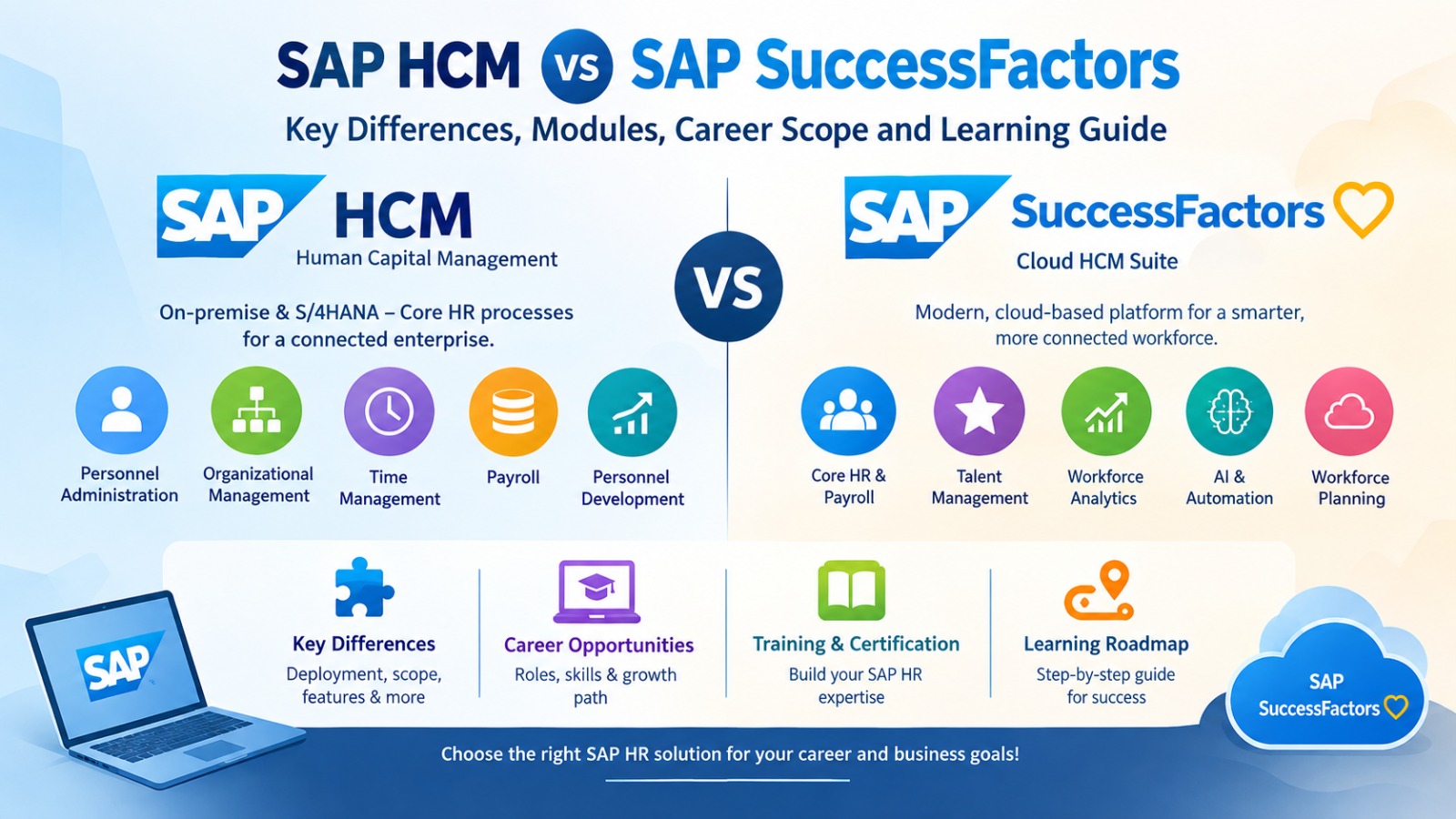
Definition — SAP Human Capital Management (SAP HCM) is an SAP solution area designed to support the management of an organization's workforce and HR-related business processes. Core areas — Depending on the implementation, SAP HCM can cover Personnel Administration, Organizational Management, Time Management, Payroll, Personnel Development and HR reporting. Technology association — Traditional SAP HCM is strongly associated with SAP's on-premise and SAP S/4HANA HR capabilities. Purpose — SAP HCM connects HR processes with organizational structures and business processes so employee-related information can be managed in a structured enterprise environment, rather than simply storing employee data.
What Is SAP SuccessFactors
Definition — SAP SuccessFactors is SAP's cloud-based HCM suite, distinct from the on-premise or S/4HANA-based SAP HCM environment. What it covers — SAP describes SuccessFactors HCM as a connected cloud HCM suite covering areas such as core HR and payroll, talent management, analytics and workforce planning. Ongoing development — SAP continues to develop AI capabilities across SuccessFactors HCM; its 1H 2026 release highlighted connected AI, skills governance and connected HR processes. Direction — SAP has described a broader move toward autonomous HCM, where AI assistants and agents can support HR processes while remaining grounded in business context and governance.
SAP HCM vs SAP SuccessFactors: Key Differences
Deployment model — SAP HCM is commonly associated with SAP's core HR capabilities in SAP ERP and SAP S/4HANA environments, while SAP SuccessFactors is cloud-based. Scope — SAP HCM centers on Personnel Administration, Organizational Management, Time Management and Payroll; SuccessFactors is positioned as a broader connected suite spanning core HR and payroll, talent management, analytics and workforce planning. Technology direction — SuccessFactors is where SAP's current AI, skills governance and connected-HR-process investments are concentrated, based on its 2026 release updates. Not identical terms — SAP HCM and SAP SuccessFactors are related but should not simply be treated as interchangeable; they represent different technology environments and capabilities. Choosing between them — The right choice depends on a professional's career objective and the technology landscape they want to work with.
How SAP HCM and SAP SuccessFactors Work Together
Not an either/or choice — Modern SAP HCM landscapes can involve integration between SAP SuccessFactors and SAP S/4HANA rather than using only one system. Example integration — SAP documentation describes integration scenarios between SuccessFactors Employee Central and SAP S/4HANA HCM. Why this matters for learners — Integration knowledge is increasingly useful for professionals working with SAP HR systems, since HR information can be relevant to other business processes such as Finance and reporting.
SAP HCM Modules You Should Know
Personnel Administration (PA) — Manages employee master data, personnel numbers, infotypes, personnel actions and organizational assignments; a foundation for many downstream HR processes. Organizational Management (OM) — Represents organizational units, jobs, positions, employees and reporting relationships, and how these objects relate to one another. Time Management — Covers work schedules, attendance, absence, leave, time recording and time evaluation, which can influence payroll calculations. Payroll — Processes employee compensation using payroll fundamentals, employee master data, payroll processing, payroll periods, results, scenarios and troubleshooting. Personnel Development — Involves employee development, qualifications, skills, career development and training-related processes. Reporting and Analytics — Helps organizations analyze employee and organizational data through HR reporting and analytics capabilities.
What SAP SuccessFactors Focuses On
Core HR and payroll — A cloud-based equivalent to many of the administrative and payroll functions found in SAP HCM. Talent management — Supports broader workforce development processes as part of the connected suite. Analytics and workforce planning — Provides workforce-level insight and planning capability within the cloud suite. AI-driven direction — Recent updates emphasize connected AI, skills governance and AI-assisted HR processes across the suite.
Which Should You Learn First
Start with fundamentals — A professional interested in SAP HR can benefit from understanding SAP HCM fundamentals such as Personnel Administration, Organizational Management, Time Management and Payroll. Then build cloud awareness — Becoming familiar with the broader SuccessFactors ecosystem complements that foundational HCM knowledge. Depends on career goal — The decision between focusing on SAP HCM, SAP SuccessFactors, or both depends on the technology landscape a professional wants to work with and their target roles.
Training and Prerequisites
No programming expertise required — There is no need to be an expert programmer to begin learning SAP HCM from a functional perspective. Helpful background — Basic HR concepts, employee lifecycle processes, organizational structures, payroll fundamentals and basic computer skills. Beginner-friendly — SAP's own beginner HCM-on-S/4HANA learning course lists no prerequisites and covers core HCM business processes. What a good program should cover — SAP HCM fundamentals, Personnel Administration, Organizational Management, Time Management, Payroll, reporting, and integration concepts including SAP SuccessFactors integration.
Certification Considerations
One part of the picture — Certification can demonstrate knowledge of a particular SAP certification track, but practical knowledge and business-process understanding are also important for professional development. Preparation focus — SAP HCM concepts, Personnel Administration, Organizational Management, Time Management, Payroll, business processes, integration concepts and scenario-based understanding. Verify current details — Certification offerings, exam structures and technologies can change, so professionals should verify the current certification path directly through SAP.
Career Opportunities Across Both Platforms
SAP HCM-focused roles — SAP HCM Consultant, SAP HR Consultant, SAP HCM Functional Consultant, SAP Payroll Consultant, SAP HCM Support Consultant, SAP HR Functional Analyst, SAP HCM Implementation Consultant and SAP HCM Business Process Consultant. Cloud-focused roles — SAP SuccessFactors Consultant, for professionals specializing in the cloud HCM suite. Progression factors — Career progression generally depends on practical knowledge, SAP experience, business-process understanding, project exposure and specialization.
The Future: Where SAP HR Technology Is Heading
Evolving landscape — AI, automation, cloud applications, workforce analytics and skills-based workforce management are becoming increasingly important areas of HCM technology. 2026 direction — SAP's 2026 HCM updates highlight connected AI capabilities, skills governance and AI-assisted HR processes across the SuccessFactors suite. Beyond individual transactions — Professionals learning SAP HR should also understand cloud HCM, HR automation, AI in HR, workforce analytics, skills management, HR integration and digital employee experiences, alongside traditional SAP HCM knowledge.
Frequently Asked Questions
QWhat is the difference between SAP HCM and SAP SuccessFactors?
SAP HCM and SAP SuccessFactors are related SAP HR technologies but represent different technology environments. SuccessFactors is SAP's cloud HCM suite, while SAP HCM is commonly associated with SAP's core HR capabilities in SAP ERP and SAP S/4HANA environments.
QIs SAP SuccessFactors replacing SAP HCM?
SAP continues to provide learning paths for SAP HCM on S/4HANA alongside SAP SuccessFactors, and the two can also be integrated together, so the right choice depends on an organization's technology landscape and an individual's career objective.
QShould I learn SAP HCM or SAP SuccessFactors first?
A professional interested in SAP HR can benefit from understanding SAP HCM fundamentals, such as Personnel Administration, Organizational Management, Time Management and Payroll, while also becoming familiar with the broader SuccessFactors ecosystem.
QCan SAP HCM and SAP SuccessFactors be used together?
Yes. Modern SAP HCM landscapes can involve integration between SAP SuccessFactors and SAP S/4HANA, including integration scenarios between SuccessFactors Employee Central and SAP S/4HANA HCM.
QWhat does SAP SuccessFactors cover?
SAP describes SuccessFactors HCM as a connected cloud HCM suite covering areas such as core HR and payroll, talent management, analytics and workforce planning.
QWhat career paths are available after learning SAP HCM or SuccessFactors?
Depending on specialization, professionals can pursue roles such as SAP HCM Consultant, SAP HR Consultant, SAP Payroll Consultant, SAP HCM Functional Analyst, SAP HCM Implementation Consultant and SAP SuccessFactors Consultant.
QIs certification necessary to work with SAP HCM or SuccessFactors?
Certification can demonstrate knowledge of a particular SAP certification track, but practical knowledge and understanding of HR business processes are also important for professional development.
✨
Conclusion
SAP HCM and SAP SuccessFactors are two connected but distinct parts of SAP's HR technology ecosystem — one rooted in SAP's on-premise and S/4HANA HR capabilities, the other a cloud-based suite built around core HR and payroll, talent management, analytics and workforce planning, with an increasing focus on connected AI and skills governance. Rather than treating the choice as either/or, the strongest foundation comes from understanding SAP HCM fundamentals such as Personnel Administration, Organizational Management, Time Management and Payroll, while also building familiarity with the SuccessFactors ecosystem and how the two integrate in real SAP landscapes. As HR technology continues to shift toward cloud applications, automation and AI-assisted processes, professionals who combine solid SAP HCM functional knowledge with awareness of SAP SuccessFactors will be better positioned across consulting, implementation, support and specialized HR technology roles.