We are hiring passionate trainers to join our growing team! Share your expertise with aspiring professionals in a dynamic learning environment. Enjoy competitive compensation, flexible schedules, and rewarding teaching experiences. Whether you're a seasoned instructor or industry expert, we provide the platform to shape futures. Apply now to become part of our elite training team!
Featured Article
SAP IBP Inventory Optimization: Strategies, Features and Benefits
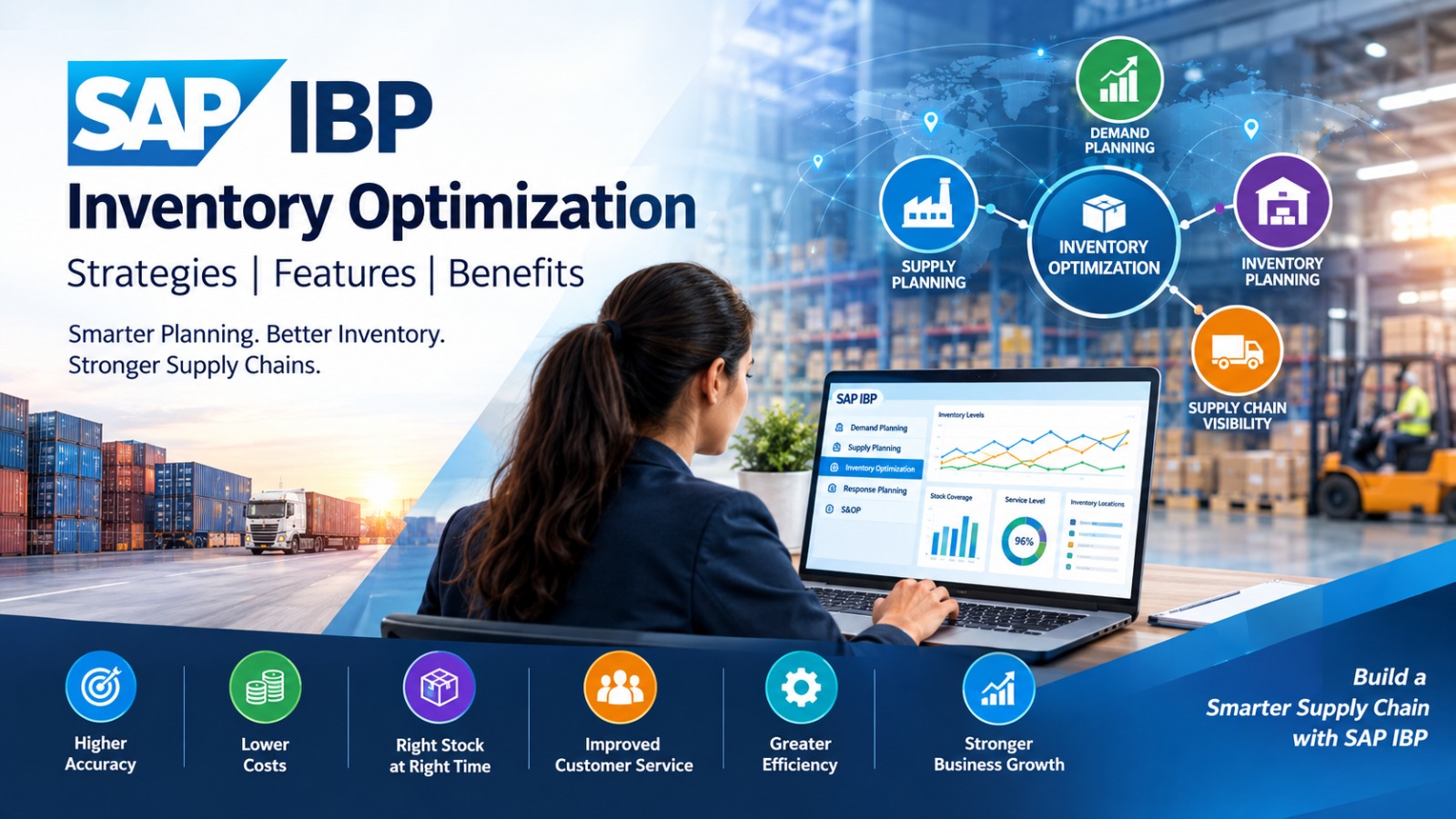
SAP IBP Inventory Optimization has become an important part of modern supply chain planning as businesses look for better ways to balance inventory availability, customer demand, working capital, and operational efficiency. Organizations across manufacturing, retail, consumer products, pharmaceuticals, automotive, and other industries increasingly rely on advanced planning technologies to make data-driven inventory decisions. SAP Integrated Business Planning (SAP IBP) provides businesses with capabilities for demand planning, supply planning, inventory optimization, response planning, and sales and operations planning. By connecting planning processes and business data, SAP IBP can help organizations understand where inventory is required, how much inventory should be maintained, and how supply plans can respond to changing demand. For professionals looking to build a career in supply chain technology, learning SAP IBP inventory optimization can provide valuable knowledge of modern supply chain planning concepts and enterprise planning processes.
8 min read
Published Today
Web Development
What Is SAP IBP Inventory Optimization
Core purpose — A capability within SAP Integrated Business Planning designed to help organizations determine appropriate inventory levels across their supply chain. Beyond spreadsheets — Replaces disconnected systems, historical-data-only approaches, and manually calculated safety-stock levels with more structured, connected inventory decisions. Balance, not minimization — The objective is not simply to keep inventory as low as possible, but to balance customer service levels, demand and supply variability, lead times, carrying costs, safety stock, working capital, and product availability. Right inventory, right place — An effective strategy focuses on maintaining the right inventory at the right location and at the right time.
Why Inventory Optimization Matters
Cost of excess inventory — Higher warehousing and carrying costs, obsolescence risk, working capital requirements, and storage needs. Cost of insufficient inventory — Stockouts, delayed deliveries, production interruptions, lost sales, and lower customer satisfaction. The core challenge — Finding how much inventory is enough, which SAP IBP helps address by analyzing demand and supply information together.
How SAP IBP Helps With Inventory Optimization
Connected planning — Inventory decisions are considered together with demand and supply requirements, rather than in isolation. Demand Planning — Uses historical data, forecasts, statistical models, and business input to create the demand foundation for inventory planning. Safety Stock Planning — Supports more systematic safety-stock planning rather than relying only on fixed, manually defined quantities. Supply Planning — Evaluates inventory requirements against production, procurement, and transportation capabilities. Lead-Time Consideration — Longer or uncertain lead times increase the need for inventory protection, informing more accurate inventory strategies. Scenario Planning — Evaluates situations such as demand spikes, supplier delays, production constraints, and new product launches before operational decisions are made.
Key Features of SAP IBP Inventory Optimization
Integrated Planning — Connects demand, supply, inventory, and other planning processes for a consistent planning picture. Inventory Target Planning and Safety Stock Analysis — Establishes inventory objectives and accounts for demand/supply uncertainty in safety-stock decisions. Demand and Supply Visibility — Helps planners identify potential inventory gaps and excesses. What-If Analysis — Evaluates the potential impact of changes before a planning decision is implemented. Supply Chain Collaboration and Analytics — Common planning information plus dashboards and reports to spot trends, exceptions, and issues.
SAP IBP Inventory Optimization Strategies
Improve demand forecast accuracy — Reduces unnecessary inventory while maintaining product availability. Optimize safety stock — Bases targets on demand variability, lead times, service levels, and supply variability rather than arbitrary numbers. Segment products — Classifies products by demand volume, variability, value, customer importance, lead time, profitability, and supply risk to apply different inventory policies. Monitor inventory exceptions — Flags excess inventory, low inventory, potential stockouts, demand spikes, supply shortages, and long lead times for quick action. Connect inventory with supply planning — Ensures inventory targets are achievable given actual supply capabilities. Use scenario planning — Compares potential outcomes, such as increased demand against available production capacity.
SAP IBP Inventory Optimization Process
Step 1: Collect Planning Data — Historical demand, forecasts, inventory levels, lead times, and supply information. Step 2: Analyze Demand — Evaluate expected demand and demand variability. Step 3: Review Supply Conditions — Consider production capacity, supplier lead times, and transportation constraints. Step 4: Determine Inventory Requirements — Evaluate inventory targets and safety-stock needs. Step 5: Analyze Exceptions — Identify potential shortages, excess inventory, or supply-demand mismatches. Step 6: Evaluate Scenarios — Compare different planning scenarios and their potential impact. Step 7: Implement the Planning Decision — Communicate the selected plan to relevant supply chain teams and systems.
Benefits of SAP IBP Inventory Optimization
Better inventory visibility — A more connected view of inventory, demand, and supply information. Reduced excess inventory and improved product availability — Helps identify overstocked areas while maintaining stock for important products. Better working capital management — Reducing unnecessary inventory frees up working capital. Faster planning decisions and improved responsiveness — Integrated data, analytics, scenario planning, and exception analysis speed up decision-making. Better collaboration — Demand, supply, and inventory planners plus procurement and business stakeholders work from a shared planning environment.
SAP IBP vs Traditional Inventory Planning
Spreadsheet-heavy vs integrated — Traditional planning relies on spreadsheets; SAP IBP offers an integrated planning environment. Manual vs advanced calculations — Manual calculations are replaced by advanced planning capabilities. Disconnected vs connected data — SAP IBP connects planning data instead of leaving it siloed. Limited vs robust scenario analysis — SAP IBP supports what-if and scenario planning versus limited traditional analysis. Delayed vs structured exception handling — SAP IBP enables more structured exception monitoring instead of delayed identification. Actual benefits depend on an organization's implementation, data quality, configuration, and user adoption.
Who Can Learn SAP IBP
Supply chain roles — Demand planners, supply planners, inventory planners, production planners, procurement and logistics professionals. SAP and technical roles — SAP consultants, SAP APO/PP/MM professionals, business analysts, and ERP consultants. New entrants — Fresh graduates interested in supply chain technology and professionals transitioning into SAP supply chain consulting. Helpful prerequisites — Supply chain management, demand/supply planning, inventory management, forecasting, ERP fundamentals, and basic data analysis, though no single background is required.
SAP IBP Learning Roadmap
Stage 1: Supply Chain Fundamentals — Demand, supply, inventory, forecasting, procurement, production, and logistics. Stage 2: SAP Fundamentals — How ERP systems support business processes. Stage 3: SAP IBP Concepts — Purpose and architecture of SAP Integrated Business Planning. Stage 4: Core Planning Areas — Demand Planning, Supply Planning, Inventory Optimization, Response Planning, and S&OP. Stage 5: Practice — Working on practical business scenarios and planning exercises. Stage 6: Implementation Concepts — Requirements gathering, configuration, testing, deployment, and support. Stage 7: Project Knowledge — Case studies and implementation scenarios showing how SAP IBP applies in real organizations.
SAP IBP Career Opportunities
SAP IBP Consultant — Supports planning requirements, implementation, configuration, and testing. SAP IBP Business Analyst — Bridges business and technical teams to translate requirements into planning solutions. Demand and Supply Planning Consultants — Focus on forecasting and demand analysis, or supply constraints and supply-demand balancing. Inventory Planning Specialist — Focuses on inventory targets, safety stock, service levels, and performance. SAP Supply Chain Consultant — Combines SAP IBP knowledge with broader supply chain skills; progression depends on experience, SAP knowledge, and project exposure.
Use Cases Across Industries
Manufacturing — Balancing raw materials, production requirements, finished goods, and customer demand. Retail — Analyzing demand and inventory requirements across products and locations. Automotive — Improving visibility across complex supplier networks and production dependencies. Pharmaceuticals — Managing product availability, demand variability, and supply constraints carefully. Consumer Products — Managing changing customer requirements and product portfolios.
Common Challenges in Inventory Optimization
Data and forecast issues — Poor-quality master data and inaccurate forecasts can undermine planning accuracy. Process and adoption gaps — Inconsistent planning parameters, lack of process standardization, and limited user adoption. System and complexity factors — Poor integration between systems, complex supply networks, and changing business requirements. Success depends on more than technology — data quality, processes, configuration, integration, governance, and user adoption all matter.
Frequently Asked Questions
QWhat is SAP IBP Inventory Optimization?
SAP IBP Inventory Optimization is part of SAP Integrated Business Planning that supports organizations in planning appropriate inventory levels while considering demand, supply, service requirements, and supply chain uncertainty.
QIs SAP IBP difficult to learn?
The difficulty depends on your previous knowledge of SAP and supply chain planning. Professionals with supply chain or SAP experience may find the concepts easier to understand, while beginners may need additional time to learn the fundamentals.
QWho should learn SAP IBP?
Supply chain professionals, demand planners, supply planners, inventory planners, SAP consultants, ERP professionals, business analysts, and graduates interested in supply chain technology can consider learning SAP IBP.
QDo I need SAP experience to learn SAP IBP?
SAP experience can be helpful but is not necessarily required for every learning path. A basic understanding of supply chain processes can provide a useful foundation.
QWhat are the major areas of SAP IBP?
SAP IBP supports several planning areas, including demand planning, supply planning, inventory-related planning, response planning, and sales and operations planning.
QWhat is safety stock in SAP IBP?
Safety stock represents inventory maintained to protect against uncertainties such as demand fluctuations and supply variability. SAP IBP provides capabilities that can support more structured safety-stock planning.
QWhat is the difference between SAP IBP and SAP APO?
SAP APO is an older SAP supply chain planning solution, while SAP IBP is SAP's cloud-based integrated business planning solution. The specific differences depend on the functionality, product version, and business scenario being evaluated.
QIs SAP IBP useful for supply chain careers?
SAP IBP knowledge can complement supply chain and SAP consulting skills, particularly for professionals working with demand, supply, inventory, and integrated planning processes.
QCan freshers learn SAP IBP?
Yes. Fresh graduates can start learning SAP IBP, although developing a foundation in supply chain concepts and enterprise software can make the learning process easier.
QIs hands-on practice important for SAP IBP?
Practical learning can help learners understand how SAP IBP concepts relate to real-world planning scenarios. It can also help develop familiarity with planning processes and implementation concepts.
QWhat skills are useful for an SAP IBP consultant?
Useful skills include supply chain knowledge, SAP IBP functionality, demand and supply planning concepts, analytical thinking, business-process understanding, communication, and practical project knowledge.
QHow long does it take to learn SAP IBP?
The learning time varies according to your previous SAP and supply chain experience, learning schedule, course coverage, and amount of practical practice.
✨
Conclusion
SAP IBP Inventory Optimization provides an integrated approach to understanding and managing inventory requirements within modern supply chains. By connecting demand, supply, inventory, and scenario planning, organizations can work toward better visibility and more informed planning decisions. For professionals, SAP IBP can also be a valuable addition to a supply chain technology skill set. Whether you are a supply chain professional, SAP consultant, business analyst, experienced planner, or graduate beginning your career, understanding SAP IBP can help you develop knowledge of modern integrated planning processes. The most effective learning approach combines SAP IBP concepts, supply chain fundamentals, hands-on practical exercises, real-world scenarios, and project-oriented learning. At ICLP Technologies, learners can build SAP IBP skills through customized and flexible learning, hands-on sessions with experienced mentors, study materials, and end-to-end support including resume preparation, interview support, placement assistance, and job support. Ready to build your SAP IBP skills? Contact ICLP Technologies to learn more about SAP IBP learning options.