We are hiring passionate trainers to join our growing team! Share your expertise with aspiring professionals in a dynamic learning environment. Enjoy competitive compensation, flexible schedules, and rewarding teaching experiences. Whether you're a seasoned instructor or industry expert, we provide the platform to shape futures. Apply now to become part of our elite training team!
Featured Article
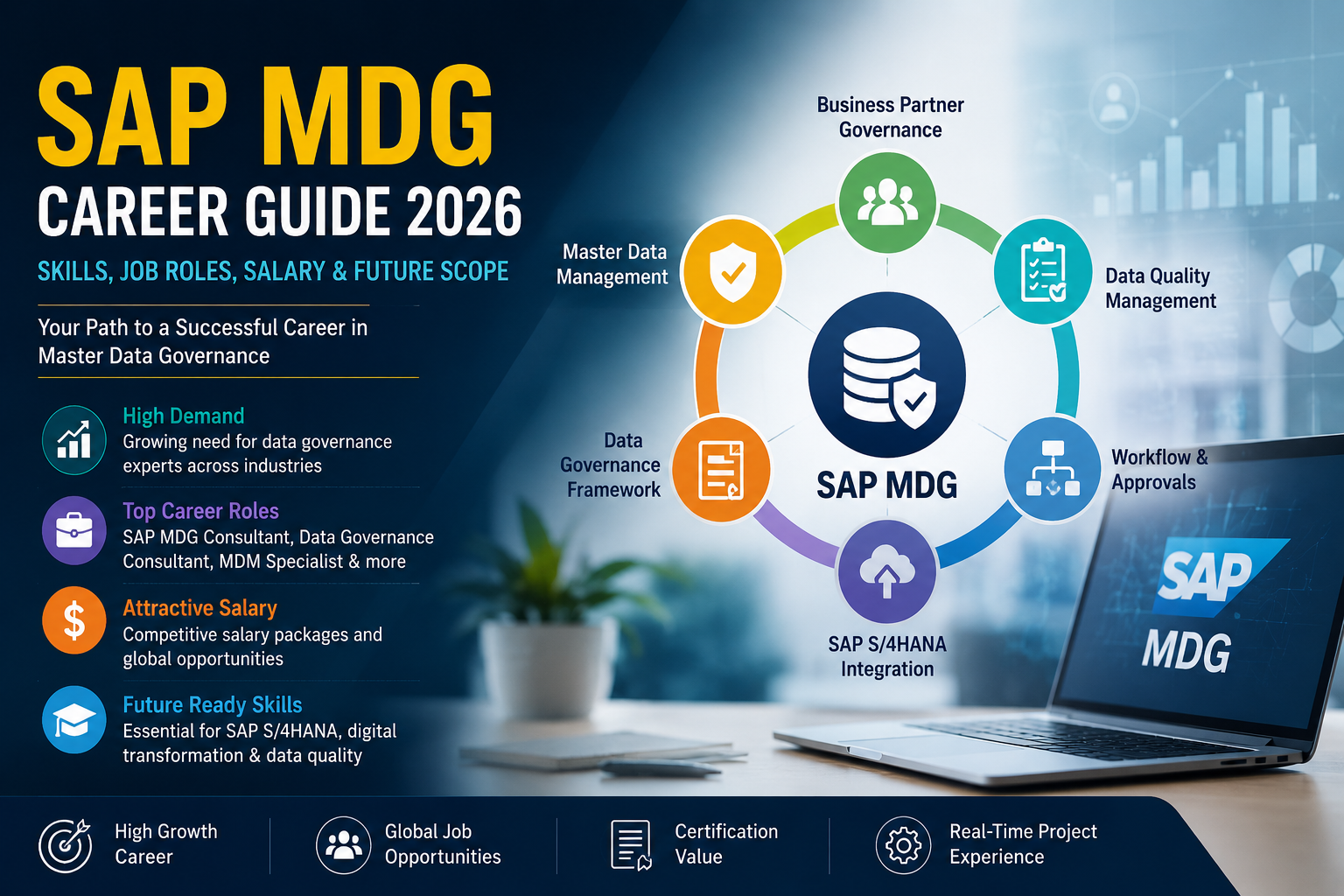
SAP MDG Career Guide: Skills, Job Roles, Salary, and Future Scope in 2026
As organizations continue their digital transformation journey, accurate master data has become a strategic business asset. SAP Master Data Governance (SAP MDG) helps enterprises govern, validate, and replicate critical master data — customers, vendors, materials, and business partners — across landscapes. Demand for SAP MDG professionals has grown sharply with global SAP S/4HANA migrations, stricter compliance requirements, and a stronger focus on data quality. This guide explains why SAP MDG matters, the essential skills to learn, typical job roles, salary expectations in 2026, and how to start a career in this domain.
8 min read
Published Today
Web Development
Why SAP MDG is Important for Modern Businesses
Centralized master data management — Single source of truth for customer, vendor, material, and business partner data. Workflow-driven approvals — Enforce governance with configurable approval flows and role-based responsibilities. Data quality validation — Implement rules to detect and prevent duplicates and inconsistent records. Governance and compliance controls — Support regulatory reporting and audit requirements with traceability. Integration with SAP S/4HANA — Native support and seamless integration for S/4HANA landscapes and downstream systems. Consistent business processes — Reduce operational friction caused by inconsistent master data across departments.
Growing Demand for SAP MDG Professionals
S/4HANA migrations — Organizations need clean, governed master data prior to cutover, increasing demand for MDG expertise. Data governance programs — Enterprises investing in data ownership, stewardship, and governance frameworks hire MDG specialists. Cross-industry demand — Manufacturing, retail, banking, healthcare, pharma, energy, logistics, and IT are actively hiring. Global opportunities — Many MDG roles involve global master-data harmonization and cross-border projects.
Essential Skills Required for SAP MDG
Master Data Governance fundamentals — Data models, lifecycle, stewardship, and governance frameworks. Business Partner Governance — Managing customer, vendor, and partner master data in MDG. Data Quality Management — Rule-based validation, deduplication, standardization, and matching logic. Workflow configuration — Configuring MDG change request processes and approval workflows. SAP S/4HANA integration — ALE/IDoc, OData, Core Data Services (CDS), and integration points with S/4HANA. Business Rules Framework (BRF+) — Implementing validations and decision logic within MDG processes. Data Replication Framework (DRF) — Replication and distribution of master data to SAP and non‑SAP systems. Technical skills (for technical roles) — MDG extension development, ABAP, UI technologies (SAPUI5/Fiori), and CDS views. Data modeling and ETL basics — Understanding of data models, mappings, and extraction/load strategies. Soft skills — Business process knowledge, stakeholder management, and data stewardship capabilities.
Job Roles Available in SAP MDG
SAP MDG Consultant — End-to-end MDG implementation, configuration, and business enablement. SAP MDG Functional Consultant — Domain-specific MDG configuration (e.g., material, customer/vendor, BP). SAP MDG Technical Consultant — Enhancements, extensions, BRF+ logic, integration patterns, and ABAP development. Data Governance Consultant — Frameworks, stewardship models, and policy implementation. Master Data Management Consultant — Strategy, data modeling, and cross-system harmonization. SAP Business Partner Consultant — Focus on business partner and customer/vendor master data. SAP S/4HANA MDG Consultant — MDG implementations tailored for S/4HANA migrations and post-migration governance. Data Quality Analyst — Monitoring, cleansing, and reporting on master data quality metrics. Enterprise Data Governance Specialist — Program-level governance, metrics, and tooling.
SAP MDG Salary Trends (2026)
Salary factors — Experience, industry, certification, S/4HANA project exposure, and geographic location determine compensation. Entry-level (0–3 years) — Competitive starting salaries for consultants with SAP fundamentals and exposure to MDG implementations. Mid-level (3–7 years) — Noticeable salary bump for hands-on MDG implementers and those with S/4HANA migration experience. Senior (7+ years) — Senior MDG consultants, architect roles, and program leads command premium packages, especially with cross-border project experience. Certifications and niche skills — BRF+, DRF, Fiori/UX, ABAP integration experience, and data governance certifications improve marketability and pay.
Future Scope of SAP MDG
Persistent relevance — As long as enterprises run complex ERP landscapes, governed master data will remain essential. Integration with advanced analytics — Trusted master data improves AI/ML, business intelligence, and predictive analytics outputs. Cloud and hybrid landscapes — MDG adoption will expand in cloud-first and hybrid SAP environments, requiring cloud integration expertise. Automation and intelligent data quality — Increasing use of ML for duplicate detection, smart matching, and automated cleansing alongside MDG workflows. Regulatory and compliance growth — Stricter data regulations and reporting needs will drive investment in governance platforms. Expanded role in MDM ecosystems — MDG will play a central role in enterprise MDM strategies, often integrated with third‑party data governance tools.
How to Start a Career in SAP MDG
Learn MDG fundamentals — Understand master data domains, governance concepts, and MDG architecture. Gain SAP foundation — Familiarize yourself with SAP S/4HANA modules relevant to your domain (MM, SD, FI/CO, etc.). Get hands-on practice — Work on sandbox systems, join implementation projects, or participate in internships to gain real experience. Master BRF+ and DRF — Learn to implement validation rules and data replication workflows in MDG. Develop integration knowledge — Study IDocs, OData services, APIs, and basic ABAP or SAPUI5 for technical tasks. Pursue certifications — SAP certifications and data governance credentials strengthen your resume. Build domain expertise — Focus on industry-specific master data needs (e.g., materials for manufacturing, product data for retail). Showcase projects — Create case studies or demos that demonstrate MDG workflows, data quality improvements, and replication setups.
Who Can Learn SAP MDG?
SAP consultants — Expand into governance and master-data services from functional backgrounds (MM, SD, FI). Data analysts and DBAs — Transition into MDG by learning governance and integration aspects. Business analysts — Leverage process knowledge to define stewardship and approval workflows. Fresh graduates — With SAP basics and strong business-process understanding, start in junior MDG roles. Career switchers — Professionals in data or ERP roles can reskill to meet MDG demand.
Why Choose a Career in SAP MDG?
High-impact role — Directly improves business reliability, compliance, and decision-making by ensuring trusted data. Strong demand — Ongoing S/4HANA projects and data governance initiatives keep MDG specialists in demand. Diverse career paths — Opportunities in consulting, in-house governance teams, data strategy, and technical development. Good compensation — Specialized skills, project experience, and certifications lead to competitive pay and rapid progression.
✨
Conclusion
SAP MDG is a strategic skill for professionals interested in enterprise data governance, S/4HANA transformations, and master-data excellence. With strong demand across industries, diverse job roles, and opportunities in both functional and technical tracks, building expertise in SAP MDG can lead to a rewarding career. Focus on hands-on experience, integration skills, and governance knowledge to stand out in the market. Start by learning MDG fundamentals, working on real projects, and pursuing relevant certifications to accelerate your career growth.