We are hiring passionate trainers to join our growing team! Share your expertise with aspiring professionals in a dynamic learning environment. Enjoy competitive compensation, flexible schedules, and rewarding teaching experiences. Whether you're a seasoned instructor or industry expert, we provide the platform to shape futures. Apply now to become part of our elite training team!
Featured Article
SAP MM Procurement Process: A Complete Guide for Beginners
Procurement is one of the most important business functions in organizations that purchase raw materials, finished products, spare parts, equipment, or services. Efficient procurement helps businesses control costs, maintain inventory levels, manage suppliers, and ensure that materials are available when required. SAP MM (Materials Management) provides organizations with tools to manage purchasing and inventory-related activities in an integrated environment, connecting purchasing departments, suppliers, warehouses, inventory teams, and finance departments. For professionals beginning their SAP journey, understanding the SAP MM Procurement Process provides a strong foundation for learning purchasing, inventory management, and SAP S/4HANA procurement.
8 min read
Published Today
Web Development
What Is SAP MM?
Core definition — SAP MM stands for SAP Materials Management, an SAP functional area used to manage materials, purchasing, inventory, suppliers, and related business processes. Scope of activities — Supports purchasing, procurement, inventory management, material master management, supplier management, goods receipt, invoice verification, stock movements, material valuation, and purchasing reporting. Cross-functional relevance — Particularly important for organizations where procurement and inventory are closely connected with manufacturing, sales, logistics, and finance.
What Is the SAP MM Procurement Process
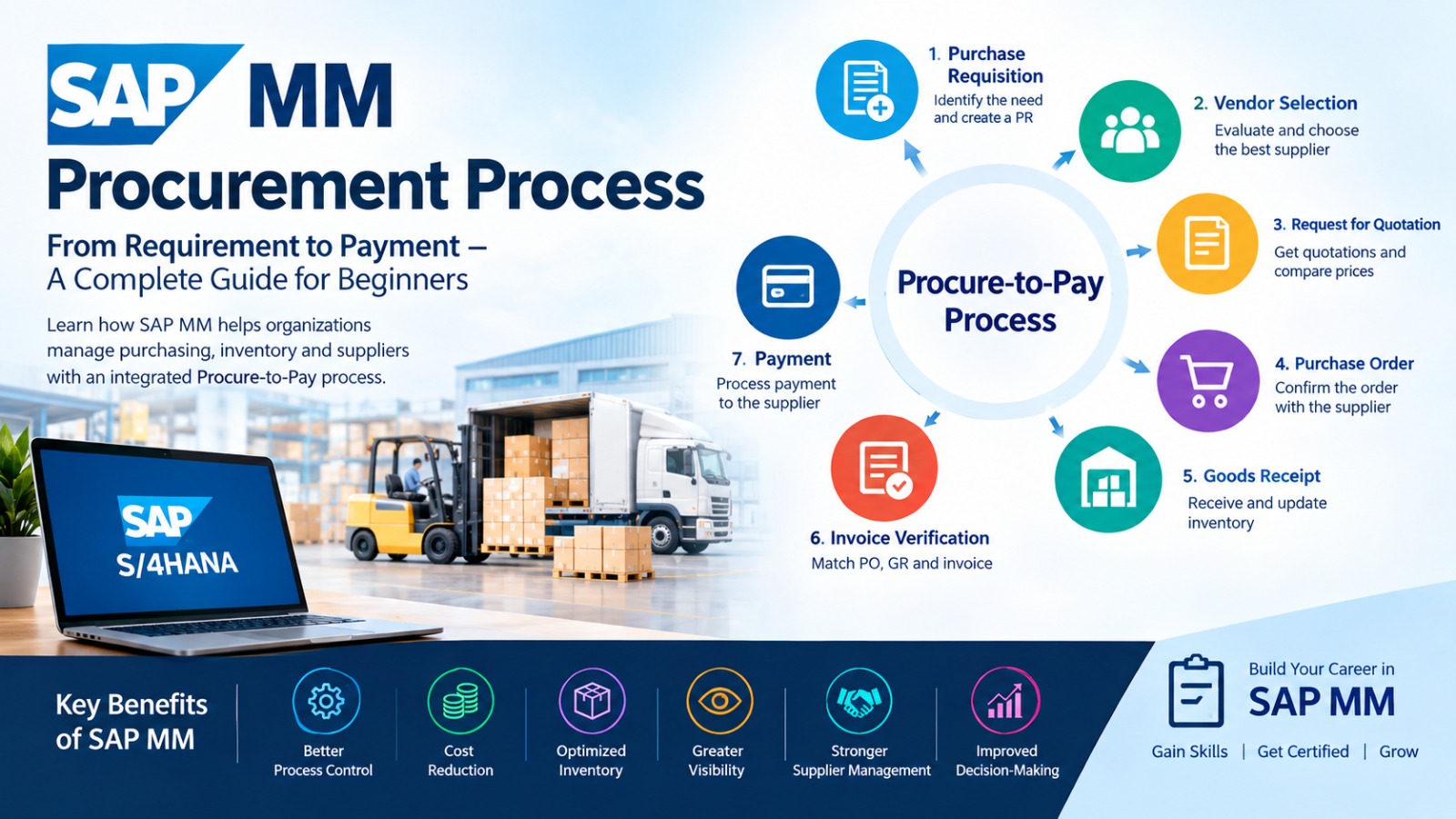
Definition — The SAP MM procurement process is the sequence of activities involved in acquiring materials or services required by an organization. Typical cycle — Requirement, Purchase Requisition, Vendor Selection, Purchase Order, Goods Receipt, Invoice Verification, and Payment. Procure-to-Pay (P2P) — This complete process is commonly referred to as the Procure-to-Pay process.
SAP MM Procurement Process Step by Step
1. Identifying the requirement — A business department identifies a need for raw materials, components, packaging, spare parts, office supplies, or maintenance services, along with quantity and delivery date. 2. Purchase Requisition (PR) — An internal request to purchase a material or service, capturing material, quantity, delivery date, plant, storage location, and account assignment for the purchasing department to review. 3. Request for Quotation (RFQ) — Sent to potential suppliers when price comparison or competitive bidding is required, so suppliers can respond with price, delivery time, quantity, and payment terms. 4. Purchase Order (PO) — Created once a supplier is selected, formally communicating supplier details, material, quantity, price, delivery date, plant, storage location, and payment terms. 5. Goods Receipt (GR) — Recorded by the receiving team when material arrives, confirming receipt against the purchase order and updating inventory quantity, material documents, and stock information. 6. Invoice Verification — The supplier's invoice is checked using three-way matching (Purchase Order + Goods Receipt + Invoice) against quantity, price, material, supplier, and purchasing conditions. 7. Payment — Once the invoice is verified and approved, payment is processed, illustrating the connection between SAP MM and SAP FI.
SAP MM Procurement Process Flow
Simplified flow — Business Requirement → Purchase Requisition → Request for Quotation → Vendor Selection → Purchase Order → Goods Receipt → Invoice Verification → Vendor Payment. Scenario-dependent — Not every procurement scenario requires every step; the exact process can vary depending on business requirements and SAP configuration.
Important SAP MM Procurement Documents
Purchase Requisition — Internal request to procure materials or services. RFQ and Quotation — Request sent to suppliers for quotations, and the supplier's commercial response. Purchase Order — Formal purchasing document sent to the supplier. Goods Receipt and Material Document — Records receipt of purchased materials and related material movement. Invoice and Accounting Document — Supplier billing document and the corresponding financial transaction record.
Key SAP MM Procurement Components
Material Master and Supplier Master Data — Contain key information about materials and suppliers used during purchasing. Purchasing Organization and Purchasing Group — Responsible for purchasing activities and represent the buyer or team handling specific procurement. Plant and Storage Location — Organizational locations where materials are procured, stored, or used, and where inventory is held within a plant. Purchasing Info Record and Source List — Store purchasing-related material-supplier information and define permitted or preferred sources of supply.
Types of SAP MM Procurement
Standard Procurement — Materials are purchased directly from an external supplier. Subcontracting — A supplier performs processing or manufacturing using components provided by the organization. Consignment — Materials are made available by a supplier while ownership remains with the supplier until consumption. Stock Transport — Materials are transferred between plants or organizational locations. Services Procurement — Organizations procure external services such as maintenance or consulting.
SAP MM Integration With Other SAP Modules
SAP MM and SAP FI — Procurement transactions can generate relevant financial postings, connecting purchasing with accounting. SAP MM and SAP SD — Materials required for sales and distribution activities can create procurement or inventory requirements. SAP MM and SAP PP — Manufacturing processes depend on the availability of raw materials and components, closely linking MM with production planning. SAP MM and SAP WM/EWM — Warehouse processes integrate with material movements and stock management. SAP MM and SAP QM — Quality processes apply when incoming materials require inspection before release for unrestricted use.
Benefits of SAP MM Procurement
Improved purchasing visibility and standardized procurement processes across the organization. More effective supplier management and inventory monitoring. Reduced manual procurement activity and improved purchasing control. Better tracking of purchase orders, goods receipts, and invoice verification. Stronger coordination between departments and a closer connection between procurement and financial processes.
Who Should Learn SAP MM
Graduates — From engineering, commerce, business, management, computer science, and related disciplines. Procurement, Supply Chain, and Inventory Professionals — Looking to strengthen SAP knowledge relevant to their current roles. Finance Professionals — Wanting to understand procurement processes and their connection with SAP FI. Working IT Professionals and Freshers — Expanding existing technical knowledge or starting fresh in SAP MM fundamentals.
SAP MM Learning Roadmap
Step 1: SAP Fundamentals — Understand SAP ERP and SAP S/4HANA basics. Step 2: Organizational Structure — Company, Company Code, Plant, Storage Location, Purchasing Organization, Purchasing Group. Step 3: Master Data — Material Master, Supplier Master, Purchasing Info Records, Source Lists. Step 4: Procurement — Purchase Requisition, RFQ, Quotation, Purchase Order. Step 5: Inventory — Goods Receipt, Goods Issue, Stock Transfer, Stock Types. Step 6: Invoice Verification — How invoices are processed and verified against procurement documents. Step 7: Integration — SAP FI, SAP SD, SAP PP, SAP QM, SAP WM/EWM. Step 8: Real-Time Projects — Practicing complete procurement scenarios from requirement through invoice verification.
SAP MM Career Opportunities
Consultant roles — SAP MM Consultant, SAP MM Functional Consultant, SAP Procurement Consultant. Analyst roles — SAP Purchasing Specialist, SAP Supply Chain Analyst, SAP Materials Management Analyst. Support and advanced roles — SAP MM Application Support Specialist and SAP S/4HANA Procurement Consultant. Career progression can depend on experience, skills, project exposure, location, employer, and specialization.
Frequently Asked Questions
QWhat is SAP MM procurement?
SAP MM procurement is the process of purchasing materials and services through SAP, covering activities such as purchase requisitions, purchase orders, goods receipts, and invoice verification.
QWhat is the P2P process in SAP MM?
P2P stands for Procure-to-Pay. It generally covers the process from identifying a purchasing requirement through procurement, receipt of goods, invoice verification, and payment.
QWhat are the main steps in SAP MM procurement?
The common steps are Purchase Requisition, RFQ/Quotation, Purchase Order, Goods Receipt, Invoice Verification, and Payment. The exact sequence can vary according to the business scenario.
QIs SAP MM difficult for beginners?
SAP MM can be learned progressively. Beginners can start with organizational structure and master data before moving into procurement, inventory, integration, and advanced topics.
QDo I need coding knowledge to learn SAP MM?
Coding knowledge is generally not required for the functional SAP MM learning path.
QWho can learn SAP MM?
Fresh graduates, procurement professionals, supply chain professionals, inventory professionals, finance professionals, and working professionals can learn SAP MM.
QWhat is the difference between SAP MM and SAP SD?
SAP MM primarily focuses on materials, procurement, purchasing, and inventory processes, while SAP SD focuses on sales and distribution processes. The two areas can integrate when business processes involve both procurement and sales.
QIs SAP MM used in SAP S/4HANA?
Yes. SAP S/4HANA includes procurement and inventory management capabilities that build on and extend traditional SAP MM functionality.
QIs SAP MM useful for supply chain careers?
SAP MM can be relevant to supply chain roles because procurement and inventory management are important components of many supply chain operations.
QCan freshers learn SAP MM?
Yes. Freshers can start with SAP fundamentals, procurement concepts, master data, inventory management, and practical business scenarios.
✨
Conclusion
The SAP MM Procurement Process is a fundamental SAP business process that connects purchasing, supplier management, inventory, goods receipt, invoice verification, and financial activities. Understanding the complete Procure-to-Pay cycle gives beginners a practical foundation for progressing into SAP MM and SAP S/4HANA procurement. For learners planning a career in SAP procurement, materials management, or supply chain, combining theoretical knowledge with hands-on scenarios and real-world procurement projects can help build a stronger understanding of how SAP is used in business environments. Start your SAP MM learning journey today with structured training covering procurement, inventory management, master data, integration, practical scenarios, and SAP S/4HANA concepts.