We are hiring passionate trainers to join our growing team! Share your expertise with aspiring professionals in a dynamic learning environment. Enjoy competitive compensation, flexible schedules, and rewarding teaching experiences. Whether you're a seasoned instructor or industry expert, we provide the platform to shape futures. Apply now to become part of our elite training team!
Featured Article
SAP PP in 2026: Complete Guide to Production Planning, Processes, Skills & Career Opportunities
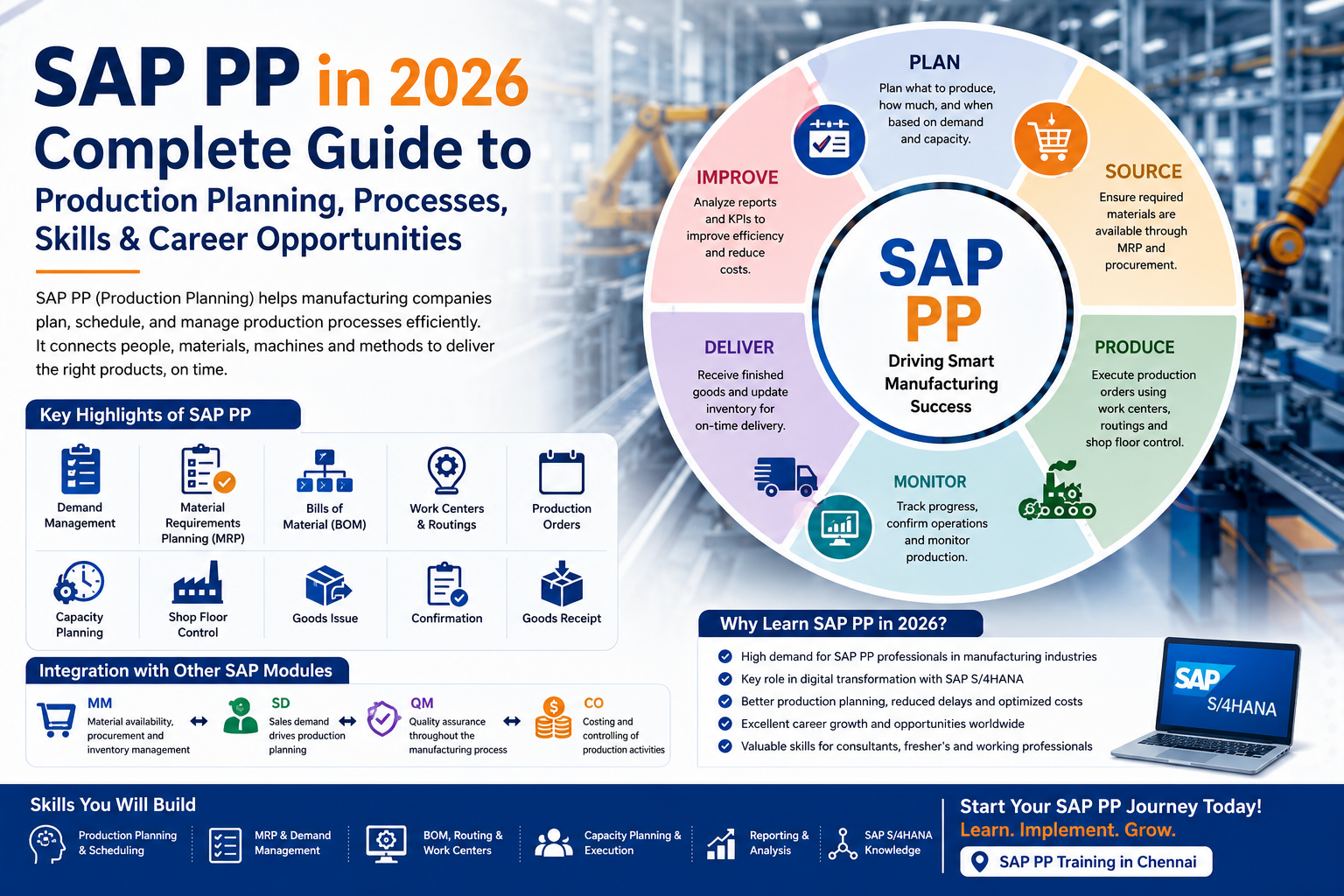
Manufacturing companies need more than machines and workers to produce products successfully. They also need proper planning to make sure the right materials are available, production happens on time, resources are used efficiently, and customer requirements are met. This is where SAP PP plays an important role. SAP PP, or SAP Production Planning, is an important SAP module used by manufacturing organizations to plan, manage, and control production activities. It connects production processes with areas such as materials management, sales, inventory, purchasing, and controlling. As more companies move toward SAP S/4HANA, the demand for professionals who understand production planning and manufacturing processes continues to create career opportunities. For anyone considering SAP PP Training in Chennai, understanding how SAP PP works in real manufacturing environments can be a valuable starting point for building a career in SAP.
8 min read
Published Today
Web Development
What Is SAP PP?
Definition — SAP PP stands for SAP Production Planning, an SAP module designed to help manufacturing organizations plan and manage their production processes. Answers core questions — Helps determine what needs to be produced, how much, when production should begin, which materials and machines are required, and when finished products should be ready. Key areas covered — Includes demand management, material requirements planning (MRP), production orders, bills of material (BOM), work centers, and routings. Additional coverage — Also spans capacity planning, shop floor control, production scheduling, goods issue, confirmation, goods receipt, and production reporting. Unified planning — Brings these activities together so businesses can plan production more effectively and maintain better control over manufacturing operations.
How SAP PP Supports Modern Manufacturing
Complex manufacturing environment — Companies often manage thousands of materials, multiple production lines, different work centers, and changing customer requirements. Common challenges — Without proper planning, businesses can face material shortages, excess inventory, machine downtime, production delays, and missed delivery commitments. Structured solution — SAP PP provides a structured way to manage these manufacturing challenges.
1. Better Production Planning
Converts demand into requirements — SAP PP helps organizations convert demand into production requirements, creating an organized manufacturing plan instead of relying on spreadsheets or manual calculations. Driven by demand and forecasts — Planning considers customer demand and sales forecasts. Accounts for inventory and capacity — Also factors in existing inventory, material availability, and production capacity. Considers timing — Takes lead times and planned production quantities into account. Training relevance — Understanding the complete production planning cycle is one of the most important parts of SAP PP Training in Chennai.
2. Material Requirements Planning (MRP)
Purpose — MRP helps organizations determine what materials are required and when they may be needed. Data considered — Looks at material requirements, current stock, open purchase orders, and planned orders. Production alignment — Also factors in production requirements and lead times. Shortage identification — Helps planners identify material shortages and plan procurement or production accordingly. Core skill — MRP is one of the most important areas for anyone learning SAP PP.
3. Bills of Material and Product Structure
Purpose of a BOM — A Bill of Material (BOM) defines the components and materials required to manufacture a product. Example structure — For a bicycle, this might include the frame, wheels, brakes, seat, handlebar, chain, and pedals. Foundation for planning — Understanding BOM structures is important because production planning depends heavily on knowing what materials and components are required.
4. Work Centers and Routings
Work centers — A work center represents a location or resource where manufacturing activities are performed. Routings — A routing defines the sequence of operations required to manufacture a product. Example operations — These can include cutting, drilling, assembly, painting, quality inspection, and packaging. Why it matters — Understanding the relationship between BOM, work center, and routing is essential for understanding production execution.
5. Production Orders and Shop Floor Execution
Execution instructions — Production orders provide the instructions required to manufacture a specific quantity of a product, including the material to be produced, quantity, and required components. Operational details — Also define the operations, work centers, scheduling information, and production dates involved. Shop floor connection — Materials are issued to the production order, activities are confirmed, and the finished product is received into inventory, connecting planning with actual execution.
6. Capacity Planning
Purpose — Capacity planning helps organizations understand whether available resources such as machines, work centers, and labor can handle the planned workload. Factors considered — Includes production hours, available working time, and planned workloads. Value — Helps planners identify potential capacity constraints and make better production decisions.
SAP PP and SAP S/4HANA
Modern SAP landscape — SAP S/4HANA has become an important part of the modern SAP landscape, with organizations adopting newer approaches to ERP, data processing, and business operations. PP within S/4HANA — SAP PP is an important part of the manufacturing processes supported within SAP S/4HANA, covering production planning, MRP, production orders, BOM management, work centers, routings, and capacity planning. Broader coverage — Also includes production scheduling, manufacturing processes, and integration with other SAP modules. Practical learning — Understanding traditional SAP PP concepts alone may not be enough; learning through practical business scenarios makes it easier to see how SAP PP works in real organizations.
Integration of SAP PP with Other SAP Modules
SAP PP and SAP MM — Production requires raw materials and components; SAP MM supports procurement and inventory management while SAP PP uses this material information for production planning. SAP PP and SAP SD — Customer demand can influence production requirements; SAP SD manages sales-related processes while SAP PP uses demand information as part of production planning. SAP PP and SAP QM — SAP QM supports quality management processes while SAP PP handles production activities, helping organizations monitor product quality during manufacturing. SAP PP and SAP CO — SAP CO helps organizations analyze costs while SAP PP provides production-related information that can contribute to cost analysis.
Why Learn SAP PP in 2026?
Growing relevance — Manufacturing companies continue to rely on enterprise systems to manage complex production operations, creating opportunities for people interested in manufacturing, ERP, supply chain, or SAP consulting. Core topics to learn — SAP PP fundamentals, production planning, MRP, BOM, work centers, and routings. Extended topics — Production orders, capacity planning, shop floor processes, and SAP S/4HANA concepts. Well-rounded training — Integration with MM, SD, QM, and CO, real-time business scenarios, and interview preparation round out a strong program. Practical exposure matters — Choosing a program that goes beyond basic definitions makes a real difference, since SAP PP is closely connected to real manufacturing processes.
How to Choose the Best SAP PP Training in Chennai
Compare content, not claims — Look at what a course actually teaches rather than choosing it only because it claims to be the best. Trainer and syllabus quality — Check trainer experience and an updated SAP S/4HANA syllabus. Practical focus — Look for practical exercises, real-time manufacturing scenarios, and hands-on practice. Core module coverage — Ensure the course covers MRP, production order configuration, BOM and routing concepts, and capacity planning. Career support — Look for SAP integration coverage, interview preparation, and career support.
SAP PP Training in Chennai for Career Development
Strong manufacturing ecosystem — Chennai has a strong manufacturing and technology ecosystem spanning automotive, engineering, electronics, industrial manufacturing, IT services, and consulting. Career foundation — For learners searching for SAP PP Training in Chennai, developing both SAP knowledge and an understanding of real manufacturing processes can help build a stronger career foundation. Beyond memorization — Learning SAP PP is about understanding how a product moves from demand and planning through materials, production, confirmation, and final inventory.
Career Opportunities After Learning SAP PP
Opens diverse roles — SAP PP knowledge can open the door to different roles within the SAP and manufacturing ecosystem, with actual roles and salary depending on experience, skills, and industry exposure. Core consulting roles — SAP PP Consultant, SAP PP Functional Consultant, and SAP S/4HANA PP Consultant. Analytical and support roles — SAP Production Planning Analyst, SAP Manufacturing Consultant, and SAP PP Support Consultant. Senior and implementation roles — SAP PP Implementation Consultant and Senior SAP PP Consultant. Added value — Professionals who understand both SAP PP and manufacturing business processes can communicate effectively with production teams and business stakeholders.
Skills Required for an SAP PP Professional
Core planning knowledge — Production planning knowledge, manufacturing process understanding, and MRP concepts. Technical module skills — BOM and routing knowledge, work center understanding, and production order processing. Modern platform skills — Capacity planning, SAP S/4HANA knowledge, and integration knowledge. Soft skills — Problem-solving, business process analysis, and communication skills. Business perspective matters — Understanding the manufacturing process from a business perspective makes SAP PP concepts much easier to apply.
What Is the Future of SAP PP?
Connected, data-driven manufacturing — The future of manufacturing is moving toward more connected, data-driven, and efficient production environments. Key focus areas — Companies are focusing on improving production visibility, reducing waste, managing materials efficiently, and improving capacity utilization. Faster response — Businesses are also working to respond faster to changes in demand. SAP's role — SAP PP and SAP S/4HANA can play an important role by connecting production planning with materials, inventory, sales, quality, and controlling processes. Winning combination — Professionals who combine SAP PP, S/4HANA, manufacturing knowledge, MRP, and integration skills can be better prepared for modern SAP projects.
Frequently Asked Questions
QWhat is SAP PP?
SAP PP stands for SAP Production Planning. It is an SAP module used to plan, manage, and control manufacturing and production processes.
QWhat does SAP PP do?
SAP PP helps organizations manage activities such as demand planning, MRP, production planning, BOMs, routings, work centers, production orders, capacity planning, and production execution.
QIs SAP PP a good career option in 2026?
SAP PP can be a good career option for people interested in manufacturing, production planning, supply chain, ERP systems, and SAP consulting.
QWho can learn SAP PP?
Manufacturing professionals, production planners, supply chain professionals, engineers, graduates, ERP professionals, and individuals interested in SAP can consider learning SAP PP.
QIs SAP PP difficult to learn?
SAP PP can become easier to understand when learners already have some knowledge of manufacturing or production processes. However, beginners can also learn the module through structured training and practical examples.
QWhat are the main components of SAP PP?
Important SAP PP areas include Demand Management, MRP, BOM, Work Centers, Routings, Capacity Planning, Production Orders, Scheduling, and Shop Floor Control.
QWhy should I choose SAP PP Training in Chennai?
SAP PP Training in Chennai can help learners understand production planning and SAP manufacturing processes in a structured training environment while gaining exposure to practical business scenarios.
QIs SAP PP used in SAP S/4HANA?
Yes. Production planning and manufacturing processes are supported within SAP S/4HANA, making S/4HANA knowledge useful for professionals planning to build a modern SAP PP career.
QWhat skills are required for an SAP PP consultant?
Important skills include production planning, manufacturing processes, MRP, BOM, routing, work centers, production orders, capacity planning, SAP S/4HANA, integration, problem-solving, and communication.
SAP PP remains a critical module for organizations that depend on structured, connected manufacturing operations, and its role continues to expand as more companies adopt SAP S/4HANA. From demand planning and MRP through BOM management, work centers, routings, and shop floor execution, SAP PP connects nearly every stage of the production lifecycle. Professionals who build strong production planning knowledge alongside S/4HANA skills and cross-module integration expertise position themselves well for a growing range of manufacturing and SAP consulting roles. If you're ready to start building these skills, enrolling in a structured SAP PP training program with practical, real-world manufacturing scenarios can help you take the first step toward a rewarding SAP career.