We are hiring passionate trainers to join our growing team! Share your expertise with aspiring professionals in a dynamic learning environment. Enjoy competitive compensation, flexible schedules, and rewarding teaching experiences. Whether you're a seasoned instructor or industry expert, we provide the platform to shape futures. Apply now to become part of our elite training team!
Featured Article
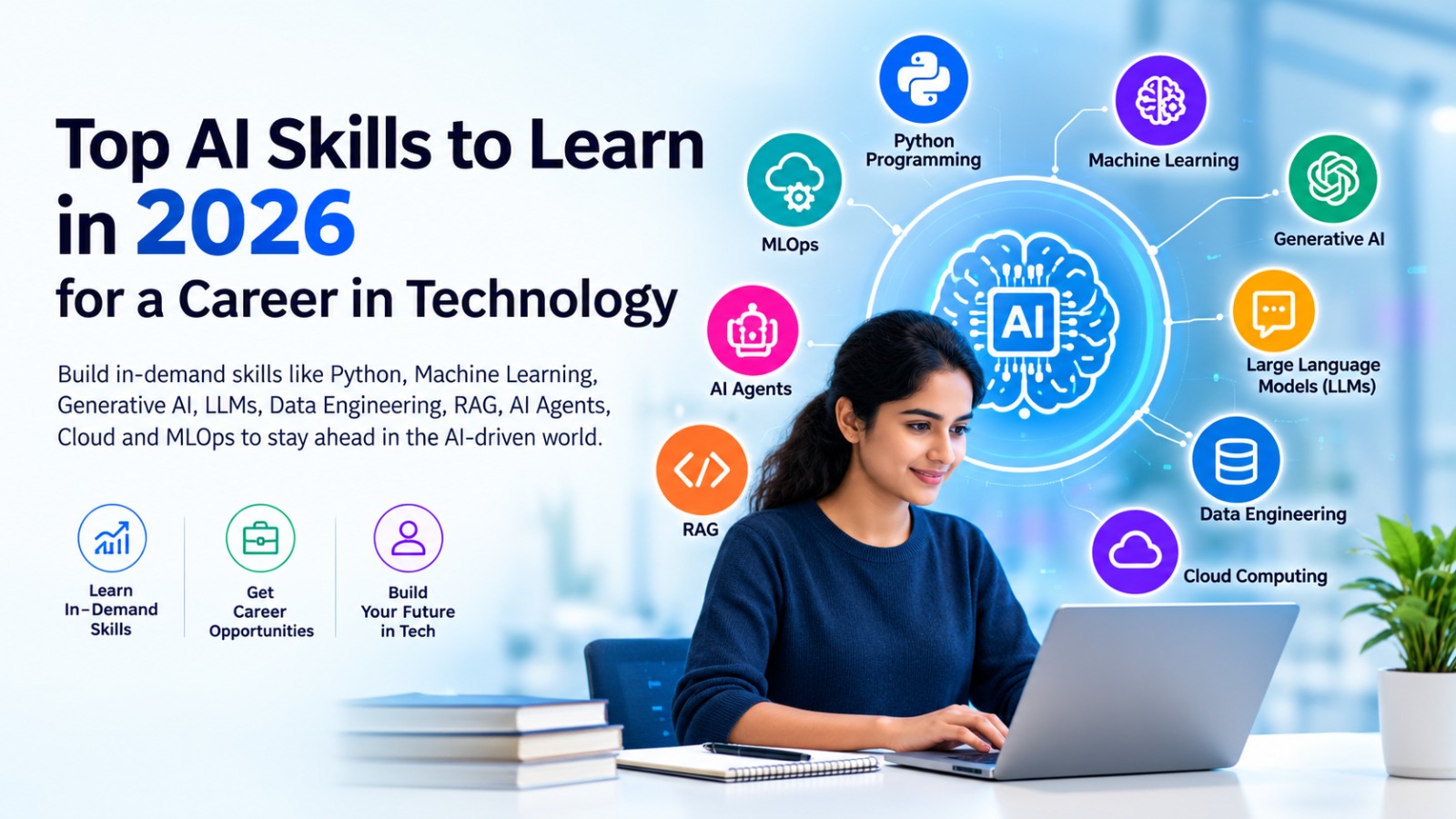
Top AI Skills to Learn in 2026 for a Career in Technology
Artificial Intelligence (AI) has become one of the most important technologies shaping the future of the IT industry. From Generative AI and Large Language Models to intelligent automation and AI-powered software applications, organisations across industries are increasingly adopting AI to improve productivity and business operations. As AI adoption continues to grow in 2026, professionals need more than basic knowledge of AI tools. Employers increasingly look for candidates who understand Python, Machine Learning, Generative AI, Large Language Models (LLMs), Data Engineering, RAG, AI Agents, Cloud Computing and MLOps. For students, fresh graduates, working professionals and career changers, developing the right combination of technical and practical AI skills can create new opportunities in the technology industry. If you are planning to build an AI career, choosing the right learning path is important. ICLP Technologies provides technology-focused training programs designed to help learners develop practical skills across Artificial Intelligence, Data Science, Python, Cloud Computing, DevOps and other in-demand technologies.
8 min read
Published Today
Web Development
Why Are AI Skills Important in 2026
Beyond big tech — AI is no longer limited to research and large technology companies; businesses use it in software development, data analysis, customer service, cybersecurity, marketing, automation and business intelligence. Beyond simple chatbots — Organisations are exploring Generative AI, AI-powered assistants, intelligent automation, RAG-based applications and AI agents that can perform multi-step tasks. Demand for practical ability — This changing landscape is creating demand for professionals who understand both AI concepts and their practical implementation. Choosing a learning path — For learners searching for AI training in Chennai, it is important to choose a path that covers both fundamental concepts and modern AI technologies.
Top AI Skills to Learn in 2026
1. Python Programming — One of the most widely used languages for AI, Machine Learning and Data Science, used for data analysis, Generative AI, Deep Learning, NLP, automation and AI application development, with libraries such as NumPy, Pandas, Scikit-learn, TensorFlow and PyTorch. 2. Artificial Intelligence and Machine Learning — Core fundamentals including supervised and unsupervised learning, regression, classification, clustering, feature engineering, model evaluation, neural networks and deep learning. 3. Generative AI — Systems that create new content such as text, images, code, audio, documents and structured information, covering LLMs, prompt engineering, AI APIs, embeddings, RAG, AI agents and model evaluation. 4. Large Language Models (LLMs) — The centre of many modern Generative AI applications; key concepts include tokens, embeddings, context windows, prompt design, LLM APIs, model selection, model evaluation and LLM application development. 5. Retrieval-Augmented Generation (RAG) — A technique for building AI applications that need organisation-specific information (User Query → Information Retrieval → Relevant Context → LLM → Generated Response), used for enterprise knowledge assistants, document search, customer support and AI research assistants. 6. AI Agents and Agentic AI — Unlike a basic chatbot, an agent can understand a task, plan actions, retrieve information, use external tools, call APIs, process data, execute workflows and return a final result. 7. Data Engineering and SQL — AI depends on high-quality data, so SQL, data cleaning, ETL and ELT, data pipelines, data warehouses, data lakes, APIs and data processing are valuable complementary skills. 8. Deep Learning — A branch of Machine Learning using neural networks for computer vision, NLP, speech recognition, image generation and Generative AI, including CNNs, RNNs, Transformers, transfer learning and frameworks like PyTorch and TensorFlow. 9. Natural Language Processing — Enabling computers to process human language for chatbots, search systems, text classification, sentiment analysis, document processing, translation and AI assistants. 10. Computer Vision — Analysing images and video for object detection, image classification, OCR, video analytics, quality inspection, face recognition and visual search; relevant to manufacturing, healthcare and robotics. 11. MLOps and AI Deployment — Deploying, monitoring, updating and maintaining AI systems using model deployment, monitoring, Docker, Kubernetes, CI/CD, cloud platforms, model versioning, data pipelines and AI application monitoring. 12. Cloud Computing for AI — Platforms such as AWS, Microsoft Azure and Google Cloud provide the infrastructure, storage, databases and AI services needed to develop and deploy applications. 13. AI Security and Responsible AI — Data privacy, access control, AI security, prompt injection, secure APIs, model security, AI governance, bias and fairness, and responsible AI. 14. Problem-Solving and Analytical Skills — Analytical thinking, logical reasoning, communication, business understanding, data interpretation and team collaboration, including judging whether AI is the right solution to a business problem.
AI Career Roadmap for 2026
Step 1: Learn Programming — Python → Git → APIs → SQL, building basic programming and database skills before advanced AI. Step 2: Learn Data Fundamentals — NumPy → Pandas → Data Cleaning → SQL → Data Analysis, to work with the data needed for Machine Learning and AI applications. Step 3: Learn AI and Machine Learning — Machine Learning → Deep Learning → NLP → Computer Vision, focusing on concepts instead of simply memorising tools. Step 4: Learn Generative AI — LLMs → Prompt Engineering → Embeddings → RAG → Vector Databases, building small applications to see how these technologies work together. Step 5: Learn AI Agents — Tool Calling → AI Agents → Agentic Workflows → API Integration, to understand how AI systems perform multi-step tasks. Step 6: Learn Cloud and Deployment — Docker → Cloud → CI/CD → MLOps → Monitoring, bridging the gap between developing and deploying an AI application. Step 7: Build Practical Projects — AI chatbot, RAG-based document assistant, AI-powered search application, customer-support assistant, resume analysis application, AI automation workflow, data prediction system and AI agent application.
Which AI Skills Should Beginners Learn First
You do not need everything at once — A practical sequence is Python → SQL → AI/ML Fundamentals → Generative AI → LLMs → RAG → AI Agents → Cloud & MLOps. Customise your path — The learning path can then be adjusted to your career objective.
AI Skills by Career Goal
Aspiring AI/ML Engineers — Python, mathematics, Machine Learning, Deep Learning, PyTorch/TensorFlow and MLOps. Generative AI Developers — Python, LLMs, prompt engineering, RAG, vector databases, AI APIs and AI agents. Data Professionals — Python, SQL, data engineering, statistics, Machine Learning and cloud. Software Developers — Programming, APIs, LLM integration, RAG, AI agents and cloud deployment.
How ICLP Technologies Can Help You Build Technology Skills
Training areas — Technology-focused programs covering Artificial Intelligence, Data Science, Python, Programming, Cloud Computing, DevOps and other IT skills. Suitable programs — Learners looking for AI courses in Chennai can explore programs based on their current knowledge, career goals and preferred technology domain. Structured learning — A structured environment helps learners understand concepts, work on practical projects and progressively develop industry-relevant technical skills.
Why Learn AI in 2026
A fast-evolving ecosystem — New models, frameworks, development approaches and applications are appearing regularly. Build transferable skills — Instead of focusing on one AI tool, build a foundation in programming, data, Machine Learning, Generative AI, LLMs, RAG, AI agents, cloud, MLOps and AI security. Adaptability — These skills provide a broader foundation for adapting to changes in the AI ecosystem.
Frequently Asked Questions
QWhat are the top AI skills to learn in 2026?
Some important AI skills include Python, Machine Learning, Generative AI, LLMs, RAG, AI Agents, Deep Learning, Data Engineering, MLOps, Cloud Computing and AI security.
QIs Python necessary for an AI career?
Python is not the only programming language used in AI, but it is one of the most widely used choices for Artificial Intelligence, Machine Learning and Data Science.
QShould I learn Generative AI or Machine Learning first?
Learning the fundamentals of Machine Learning can provide a strong foundation, while Generative AI can be explored alongside those fundamentals depending on your career goals.
QWhat is RAG in Generative AI?
RAG stands for Retrieval-Augmented Generation. It allows an AI application to retrieve relevant information from an external knowledge source and provide that information as context to an LLM.
QWhat are AI Agents?
AI Agents are AI-powered systems designed to perform tasks by using reasoning, tools, external information and workflows depending on their design.
QCan beginners learn Artificial Intelligence?
Yes. Beginners can start with programming and data fundamentals and gradually progress into Machine Learning, Generative AI and advanced AI application development.
QCan non-IT professionals learn AI?
Yes. Non-IT professionals can start with basic programming, Python and data concepts before progressing toward Artificial Intelligence and Generative AI.
QWhere can I learn AI in Chennai?
Learners looking for AI training in Chennai can explore structured Artificial Intelligence and Data Science programs at training institutes such as ICLP Technologies, based on their career objectives and technical background.
✨
Conclusion
Artificial Intelligence is transforming the technology industry, and the skills required for AI careers are expanding beyond traditional Machine Learning. In 2026, professionals can benefit from developing a combination of Python, SQL, Machine Learning, Generative AI, LLMs, RAG, AI Agents, Data Engineering, Cloud Computing and MLOps. The most effective approach is to learn the fundamentals, practise through real-world projects and continuously update your knowledge as AI technologies evolve. If you are planning to build a career in Artificial Intelligence, Data Science or other emerging technology domains, explore the relevant AI and IT training programs at ICLP Technologies and choose a learning path aligned with your career goals.