We are hiring passionate trainers to join our growing team! Share your expertise with aspiring professionals in a dynamic learning environment. Enjoy competitive compensation, flexible schedules, and rewarding teaching experiences. Whether you're a seasoned instructor or industry expert, we provide the platform to shape futures. Apply now to become part of our elite training team!
Featured Article
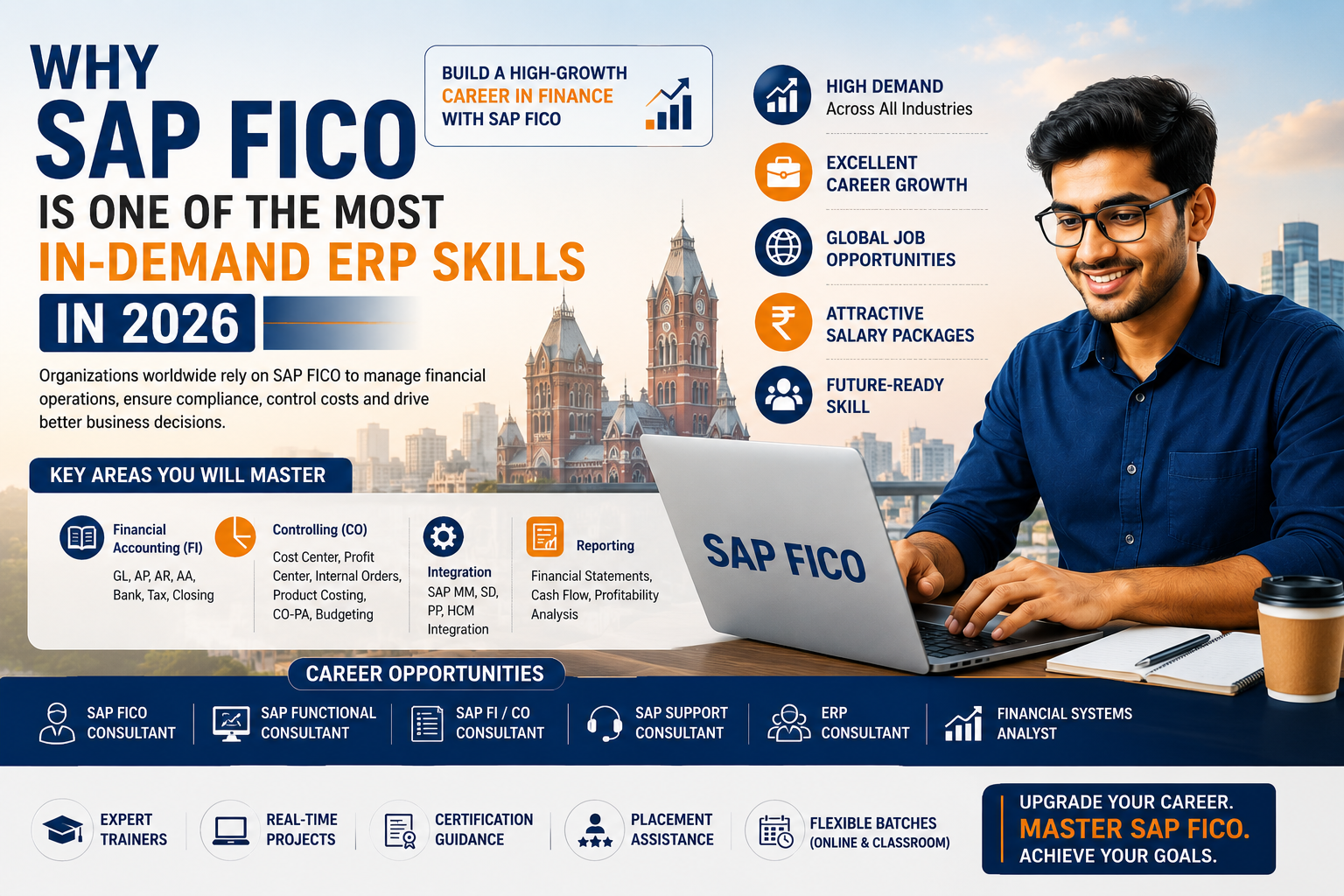
Why SAP FICO is One of the Most In-Demand ERP Skills in 2026
The business world is rapidly moving toward digital finance, automation, cloud ERP, and intelligent business processes. As organizations migrate from traditional accounting software to enterprise-level ERP systems, SAP FICO has emerged as one of the most valuable skills for finance professionals. Whether you're a commerce graduate, accountant, finance executive, MBA, CA, CMA, or an IT professional looking to enter the SAP ecosystem, learning SAP FICO can open doors to rewarding careers across industries. Unlike traditional accounting software, SAP FICO integrates financial operations with procurement, sales, manufacturing, inventory, human resources, and reporting, enabling organizations to make faster and more accurate business decisions.
8 min read
Published Today
Web Development
What Makes SAP FICO Different from Traditional Accounting Software?
Beyond small-business tools — Applications like Tally, Zoho Books, or QuickBooks suit small and medium businesses, but large enterprises need a centralized ERP platform managing multiple functions across locations. Enterprise-wide financial management — Handles complex, multi-entity financial operations at scale. Real-time financial reporting — Immediate visibility into financial performance. Multi-company accounting — Manage several legal entities within one system. Global tax compliance — Built-in support for varying regulatory requirements. Cost and profit center management — Granular tracking of financial performance by unit. Budget planning and automated financial closing — Streamlined, integrated business processes across the enterprise.
Why Companies Invest in SAP FICO
Automated accounting processes — Reduces manual effort and errors. Better financial visibility — Real-time insight into financial health. Accurate cost allocation and improved profitability analysis — Supports precise financial decision-making. Faster financial reporting and audit-ready records — Simplifies compliance and reporting cycles. Better decision-making — Data-driven insights across the organization. Integration with all SAP modules — Seamless connectivity across business functions as digital transformation accelerates.
Industries That Rely on SAP FICO
Banking & Financial Services and Information Technology — Core sectors with heavy SAP FICO adoption. Manufacturing, Automotive, and Energy & Utilities — Industries requiring robust cost and financial control. Healthcare and Pharmaceutical — Regulatory-driven financial management needs. Retail, Logistics, and E-Commerce — Fast-paced sectors relying on real-time financial data. Telecommunications and Aviation — Large-scale enterprises with complex financial structures. Universal relevance — Because finance exists in every organization, SAP FICO skills remain relevant regardless of industry.
Top Skills Every SAP FICO Professional Should Learn
Financial Accounting — General Ledger, Accounts Payable, Accounts Receivable, Asset Accounting, Tax Configuration, Bank Accounting, and Financial Closing. Controlling — Cost Center Accounting, Profit Center Accounting, Internal Orders, Product Costing, Cost Allocation, and Profitability Analysis. Business skills — Financial Reporting, Business Process Mapping, Documentation, and Requirement Gathering. Soft skills — Analytical thinking and communication are increasingly valued alongside technical SAP knowledge.
SAP FICO Career Roadmap
SAP End User — Entry point into the SAP ecosystem. SAP Support Consultant — Building troubleshooting and system knowledge. SAP Functional Consultant — Hands-on configuration and implementation experience. Senior SAP Consultant and SAP Lead Consultant — Growing responsibility and project ownership. SAP Solution Architect and SAP Project Manager — Leadership and strategic roles reached through implementation experience and industry exposure.
Common Challenges Faced by SAP FICO Beginners
Understanding accounting concepts — Foundational knowledge that supports SAP configuration. Learning enterprise business processes — Grasping how finance connects to broader operations. Configuring SAP settings — Technical setup can be complex for newcomers. Integration with MM and SD modules — Understanding cross-module dependencies. Financial document flow and real-time reporting — Core concepts that take practice to master. Structured learning helps — A guided approach with practical exercises and live scenarios helps overcome these challenges.
SAP FICO Interview Preparation Tips
Financial Accounting concepts — Employers assess core accounting understanding. SAP Navigation and Configuration Understanding — Practical system familiarity matters. Business Process Knowledge — Ability to relate SAP functions to real business operations. Integration Scenarios and problem-solving ability — Demonstrating cross-module thinking. Practice matters — Preparing with mock interviews and real-world case studies can improve confidence and interview performance.
How Hands-on Projects Improve Employability
Theory isn't enough — Practical exposure demonstrates real understanding of business scenarios. Company Code Configuration and Chart of Accounts — Foundational project experience. Customer & Vendor Setup and Tax Configuration — Core functional exercises. Asset Management and Cost Center Creation — Building operational configuration skills. Profit Center Accounting and Financial Closing Process — Realistic scenarios that build confidence for consulting and support roles.
SAP FICO in the Era of SAP S/4HANA
Migration trend — Many organizations are moving from SAP ECC to SAP S/4HANA to modernize finance operations. Universal Journal (ACDOCA) — A unified data structure simplifying financial reporting. Real-time analytics and embedded reporting — Faster access to financial insights. Simplified Finance and intelligent automation — Streamlined processes with reduced manual work. Cloud integration and faster financial close — Professionals familiar with these concepts will be better prepared for current and future ERP projects.
How to Choose the Right SAP FICO Training Institute
Experienced SAP trainers and live instructor-led sessions — Quality of instruction matters. Hands-on practice and real-time projects — Practical exposure builds job readiness. Updated SAP S/4HANA curriculum — Ensures relevance to current industry needs. Certification guidance and interview preparation — Support beyond just technical training. Placement assistance and flexible learning options — A practical training approach helps bridge the gap between learning and employment.
Frequently Asked Questions
QIs SAP FICO suitable for freshers?
Yes. Graduates with a background in commerce, finance, business, or accounting can start learning SAP FICO.
QDo I need accounting knowledge?
Basic accounting knowledge is helpful, but many concepts are covered during structured training.
QDoes SAP FICO require coding?
No. SAP FICO is primarily a functional module focused on finance and business processes.
QIs SAP FICO useful outside India?
Yes. SAP is widely used by multinational organizations, creating opportunities in many countries.
QHow long does it take to learn SAP FICO?
Most learners complete the fundamentals in 2–4 months, depending on the learning mode and practice.
✨
Conclusion
SAP FICO continues to be one of the most valuable ERP specializations for professionals interested in finance, accounting, and enterprise consulting. As organizations continue investing in digital transformation and intelligent finance systems, the demand for skilled SAP FICO consultants is expected to remain strong. If your goal is to build a long-term career in enterprise finance, learning SAP FICO with practical exposure, project experience, and industry guidance can provide a solid foundation for future growth.